2026-09-14
Where Your Elements Came From
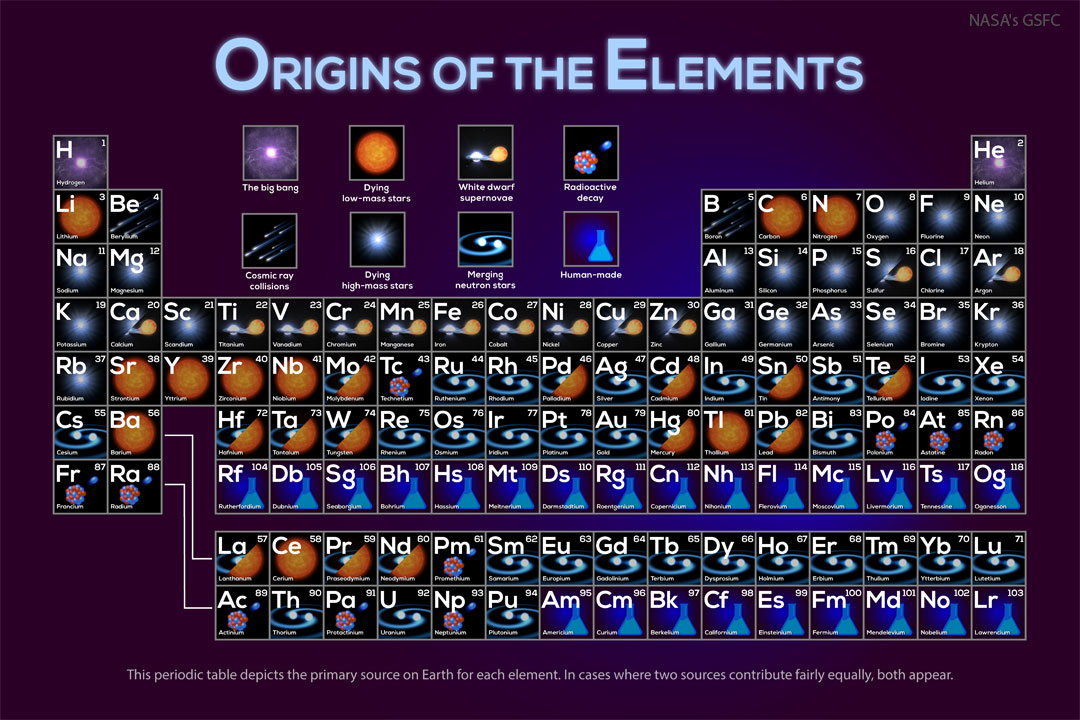
Another stunning view from the cosmos: Where Your Elements Came From. NASA explains:
Why this matters
This scene highlights deep-space objects. The same physics that lets us photograph it also lets us predict where objects will be tomorrow — which is exactly what real-time tracking is built on.
See it live on ObjectTracer
This connects to what you can track in real time on our 3D globe — explore Deep Space galaxy map. Or open the live globe to watch flights, satellites, the ISS and spacecraft move right now.
The science, from NASA's Astronomy Picture of the Day
The hydrogen in your body and present in every molecule of water came from the Big Bang. There are no other appreciable sources of hydrogen in the universe. The carbon in your body was made by nuclear fusion in the interior of stars, as was the oxygen. Much of the iron in your body was made during supernovas of stars that occurred long ago and far away. The gold in your jewelry was likely made from neutron stars during collisions that may have been visible as short-duration gamma-ray bursts or gravitational wave events. Elements like phosphorus and copper are present in our bodies in only small amounts but are essential to the functioning of all known life. The featured periodic table is color coded to indicate humanity's best guess as to the nuclear origin of all known elements. The sites of nuclear creation of some elements, such as copper, are not really well known and are continuing topics of observational and computational research. APOD's main NASA site is moving: From apod.nasa.gov to science.nasa.gov/apod
Source: NASA Astronomy Picture of the Day (public domain)
More from the Space Journal
- M83: The Southern Pinwheel2026-09-11
- LDN 1295: The Giraffe Nebula2026-09-10
- Witness XZ Andromedae Wink2026-09-09
- Buck Moon and Belt of Venus2026-08-01
- A Messier Moment for Tempel 22026-08-08
- Bright Perseids from Sweden2026-08-15