2026-06-17
Longmore 8: The Hamster Wheel Nebula
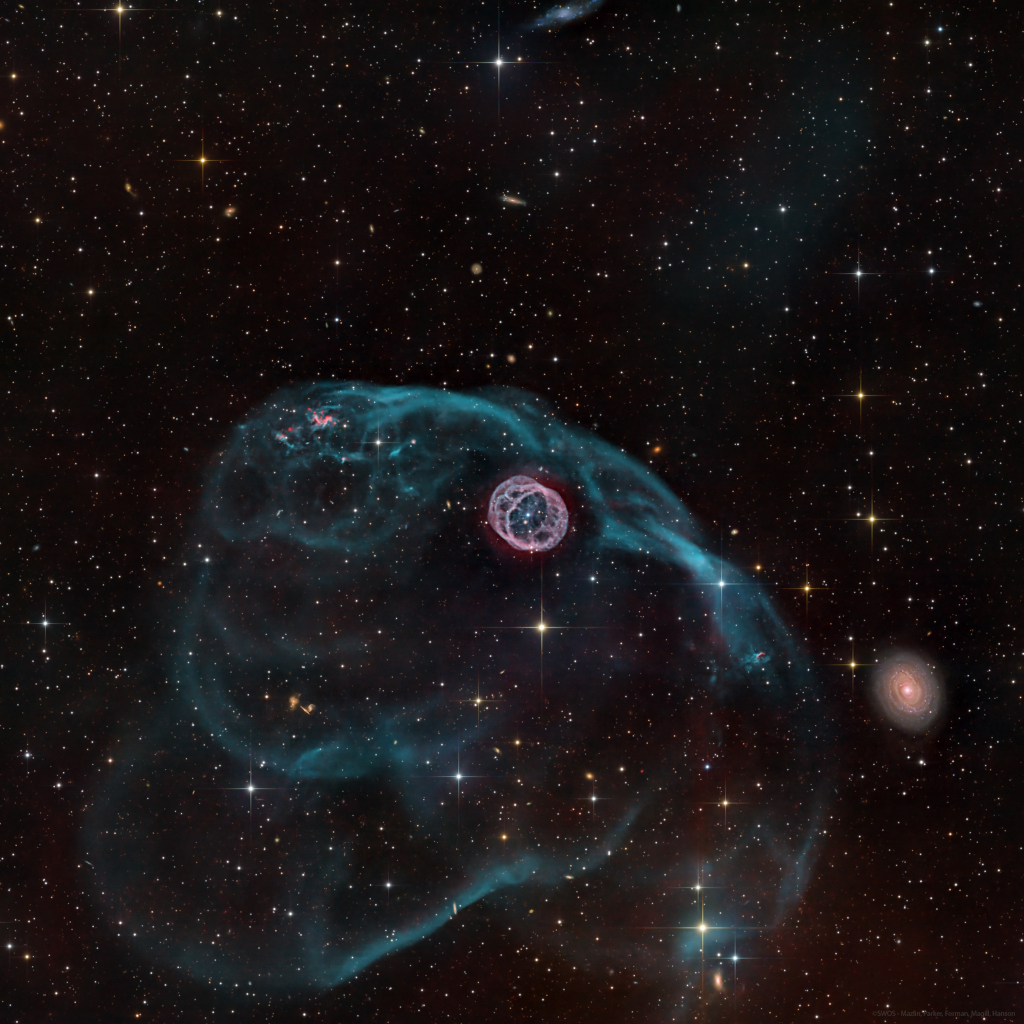
Another stunning view from the cosmos: Longmore 8: The Hamster Wheel Nebula. NASA explains:
Why this matters
This scene highlights deep-space objects. The same physics that lets us photograph it also lets us predict where objects will be tomorrow — which is exactly what real-time tracking is built on.
See it live on ObjectTracer
This connects to what you can track in real time on our 3D globe — explore Deep Space galaxy map. Or open the live globe to watch flights, satellites, the ISS and spacecraft move right now.
The science, from NASA's Astronomy Picture of the Day
How did a hamster wheel get into space? The Hamster Wheel Nebula (Longmore 8) was discovered by Andrew Longmore in 1976 as a part of a larger survey of the southern sky. This survey employed several improvements in photographic technology, including the use of highly sensitive film, to capture deeper and fainter objects on plates that were examined by eye and catalogued. The featured image, taken at Observatorio El Sauce in Chile, depicts an intricate wheel structure of glowing hydrogen that was thrown out into space by a dying star and ionized by the leftover white dwarf. This structure was barely visible on the original plate, emphasizing the power of modern telescopes and cameras. Two opposing clumps of red hydrogen gas encased in the blue veil of ionized oxygen hint at the presence of a companion to the bright white dwarf at the wheel’s center!
Image credit: Mazlin, Parker, Forman, Magill, Hanson Text: Keighley Rockcliffe (NASA GSFC, UMBC CSST, CRESST II) · Source: NASA APOD
More from the Space Journal
- Vaporizing Meteor Photobombs the Lacerta Nebula2026-08-03
- NGC 4372 and the Dark Doodad2026-07-31
- Barnards Loop over Twin Volcanoes2026-07-28
- AR 4478: Giant Sunspot Group2026-06-28
- Week 1: Engineering Challenges Behind ObjectTracer2026-07-12
- RCW 86: Historical Supernova Remnant2026-07-24