2026-07-31
NGC 4372 and the Dark Doodad
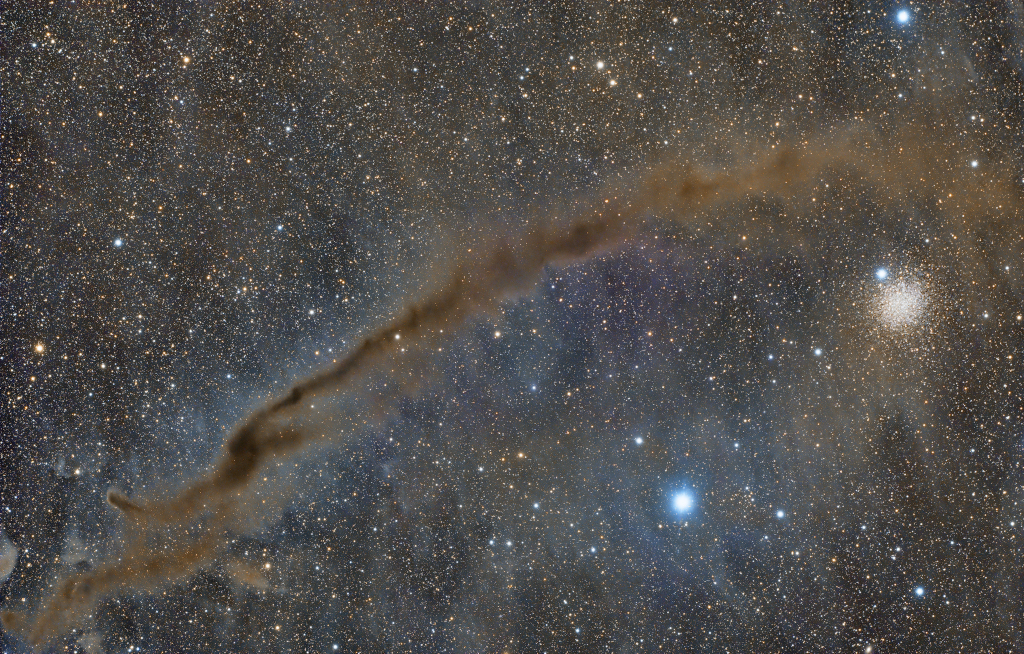
A fresh look at our universe: NGC 4372 and the Dark Doodad. NASA's take:
Why this matters
Today's highlight centers on deep-space objects, near-Earth objects. Understanding how these objects form and move is the bridge between a pretty photo and the live, data-driven sky we render on the globe.
See it live on ObjectTracer
This connects to what you can track in real time on our 3D globe — explore Deep Space galaxy map · Asteroid tracker. Or open the live globe to watch flights, satellites, the ISS and spacecraft move right now.
The science, from NASA's Astronomy Picture of the Day
The Dark Doodad Nebula drifts through southern skies, a tantalizing target for binoculars toward the small constellation Musca, The Fly. A dusty interstellar cloud, it's seen against rich starfields just south of the Coalsack Nebula and the Southern Cross. Stretching for about 3 degrees across this telescopic field of view, the Dark Doodad is punctuated near its southern tip (upper right) by yellowish globular star cluster NGC 4372. Of course NGC 4372 roams the halo of our Milky Way galaxy, a background object some 20,000 light-years away and only by chance along our line-of-sight to the Dark Doodad. About 700 light-years distant and over 30 light-years long, the Dark Doodad's well defined silhouette belongs to the potentially star-forming Musca molecular cloud. The dusty Dark Doodad's delightfully alliterative moniker was first coined by astro-imager and writer Dennis di Cicco in 1986 while observing Comet Halley from the Australian outback.
Image credit: Alessandro Cipolat Bares · Source: NASA APOD
More from the Space Journal
- Perseids Over a little Planet2026-08-12
- A Messier Moment for Tempel 22026-08-08
- Curious Cometary Knots in the Helix Nebula2026-08-04
- Earth's Shadow Visualized with Lunar Eclipses2026-08-25
- M74: A Grand Design Spiral2026-08-30
- Nā ʻUhane Māhoe Huki Pū i ke Ola2026-09-04
← Red Sun through Wildfire Smoke · Buck Moon and Belt of Venus →