2026-08-04
Curious Cometary Knots in the Helix Nebula
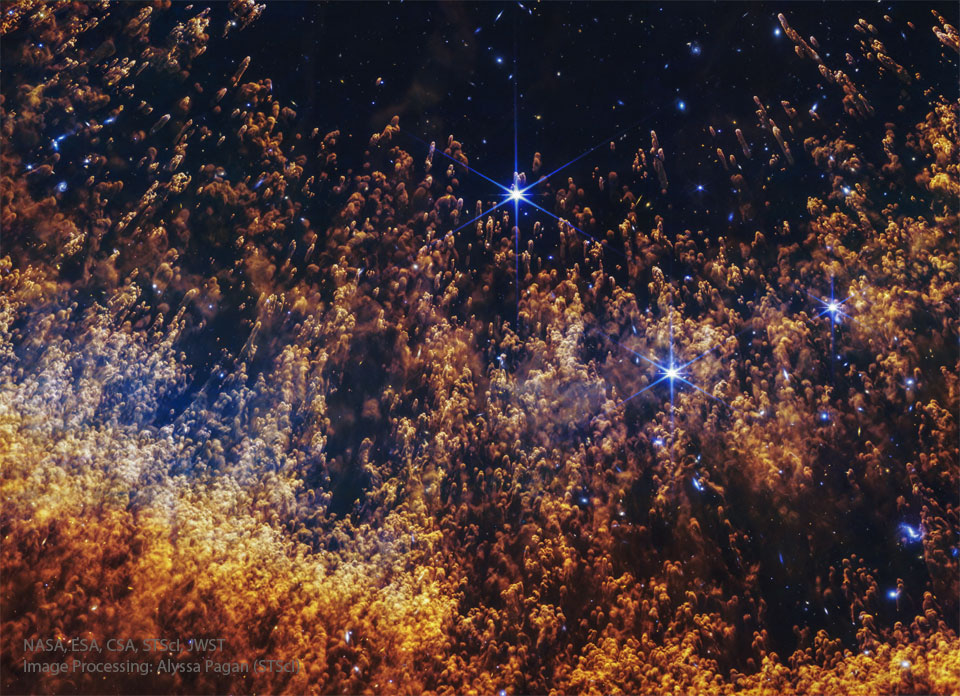
Space never stops amazing us. Today: Curious Cometary Knots in the Helix Nebula. Here is the science:
Why this matters
Today's view is a window onto deep-space objects, the planets, near-Earth objects. Images like this aren't just beautiful — they're how astronomers measure distance, motion and the deep history of the universe, turning faint light into hard data.
See it live on ObjectTracer
This connects to what you can track in real time on our 3D globe — explore Deep Space galaxy map · Solar System view · Asteroid tracker. Or open the live globe to watch flights, satellites, the ISS and spacecraft move right now.
The science, from NASA's Astronomy Picture of the Day
What causes unusual knots of gas and dust in planetary nebulas? Seen also in the Ring Nebula, the Dumbbell Nebula and NGC 2392, the knots' existence was not initially predicted, and their origins are still not well understood. Pictured here is a fascinating image of part of the Helix Nebula by the James Webb Space Telescope showing tremendous detail in infrared light. The cometary knots have masses similar to the Earth but have sizes typically several times the orbit of Pluto. One hypothesis for the fragmentation and evolution of the knots includes existing gas being driven out by a less dense but highly energetic stellar wind of the central evolving star. The Helix Nebula is one of the closest examples of a planetary nebula created at the end of the life of a Sun-like star. Given a technical designation of NGC 7293, the Helix Nebula lies about 650 light-years away towards the constellation of Water Carrier (Aquarius). Open Science: Browse 4,000+ codes in the Astrophysics Source Code Library
Source: NASA Astronomy Picture of the Day (public domain)
More from the Space Journal
- Perseids Over a little Planet2026-08-12
- Witness XZ Andromedae Wink2026-09-09
- Launch of the Roman Space Telescope2026-08-31
- NGC 4372 and the Dark Doodad2026-07-31
- A Plane Lunar Eclipse2026-09-01
- Total Solar Eclipse from Greenland2026-08-14
← Vaporizing Meteor Photobombs the Lacerta Nebula · Spokes on Saturn's B Ring →