2026-08-25
Earth's Shadow Visualized with Lunar Eclipses
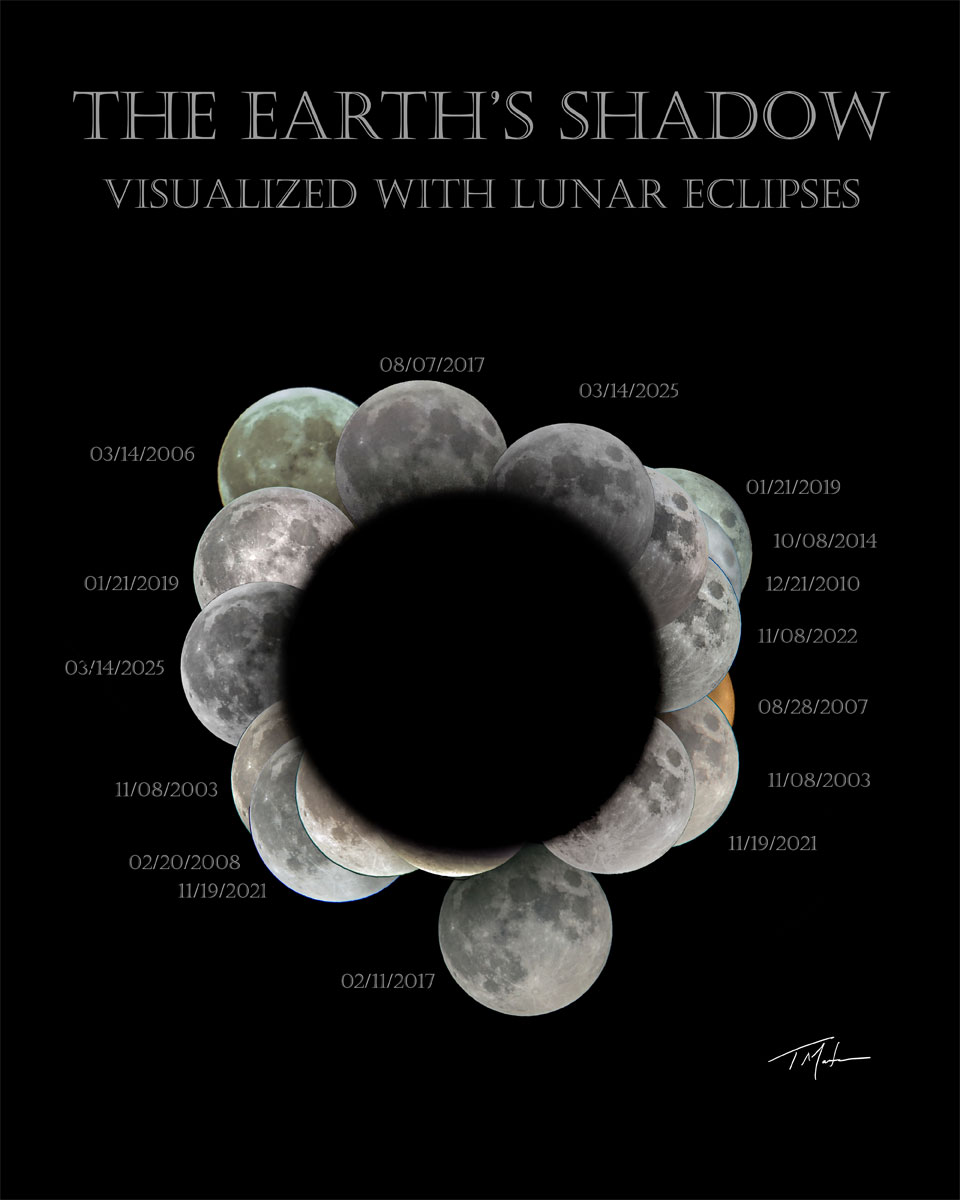
The universe showed off again today: Earth's Shadow Visualized with Lunar Eclipses. Here is what NASA captured:
Why this matters
Behind the picture is the Moon, solar activity, the night sky. Light that left these objects long ago is only reaching us now, which is why a single image can double as a snapshot of the distant past.
See it live on ObjectTracer
This connects to what you can track in real time on our 3D globe — explore Moon tracker · Solar System view · Deep Space. Or open the live globe to watch flights, satellites, the ISS and spacecraft move right now.
The science, from NASA's Astronomy Picture of the Day
What’s creating this giant hole in space? This is not a black hole — it’s a shadow. It’s Earth’s shadow. Since at least the time of Aristotle, people have noted that Earth's dark shadow on the Moon during a partial lunar eclipse is circular -- although never a whole circle. Using modern digital technology, though, the images of multiple lunar eclipses can be combined to show Earth's complete shadow. The featured image compilation by a perseistent astrophotographer is constructed from 22 years of lunar eclipses. The Moon is not eclipsed every month (moon-th) because the Moon's orbit is slightly tilted relative to Earth's orbit. Close inspection of some lunar eclipse images shows a faint blue band where Earth’s atmosphere filters out more red sunlight than blue. Later this week, a new lunar eclipse will occur and will be best visible in parts of North and South America, Europe, and Africa. APOD's main NASA site is moving : From apod.nasa.gov to science.nasa.gov/apod
Image credit: Tim Martin · Source: NASA APOD
More from the Space Journal
- Chasing the Moon's Shadow2026-09-05
- The Eclipse and the Stork2026-09-03
- Solar Eclipses and Culture2026-09-02
- Time-Lapse of the Star S301 Orbiting the Black Hole in the Center of the Galaxy2026-08-21
- Launch of the Roman Space Telescope2026-08-31
- LDN 1295: The Giraffe Nebula2026-09-10
← Comet 220P in Outburst · JWST Images The Lion's Head Nebula →