2026-09-03
The Eclipse and the Stork
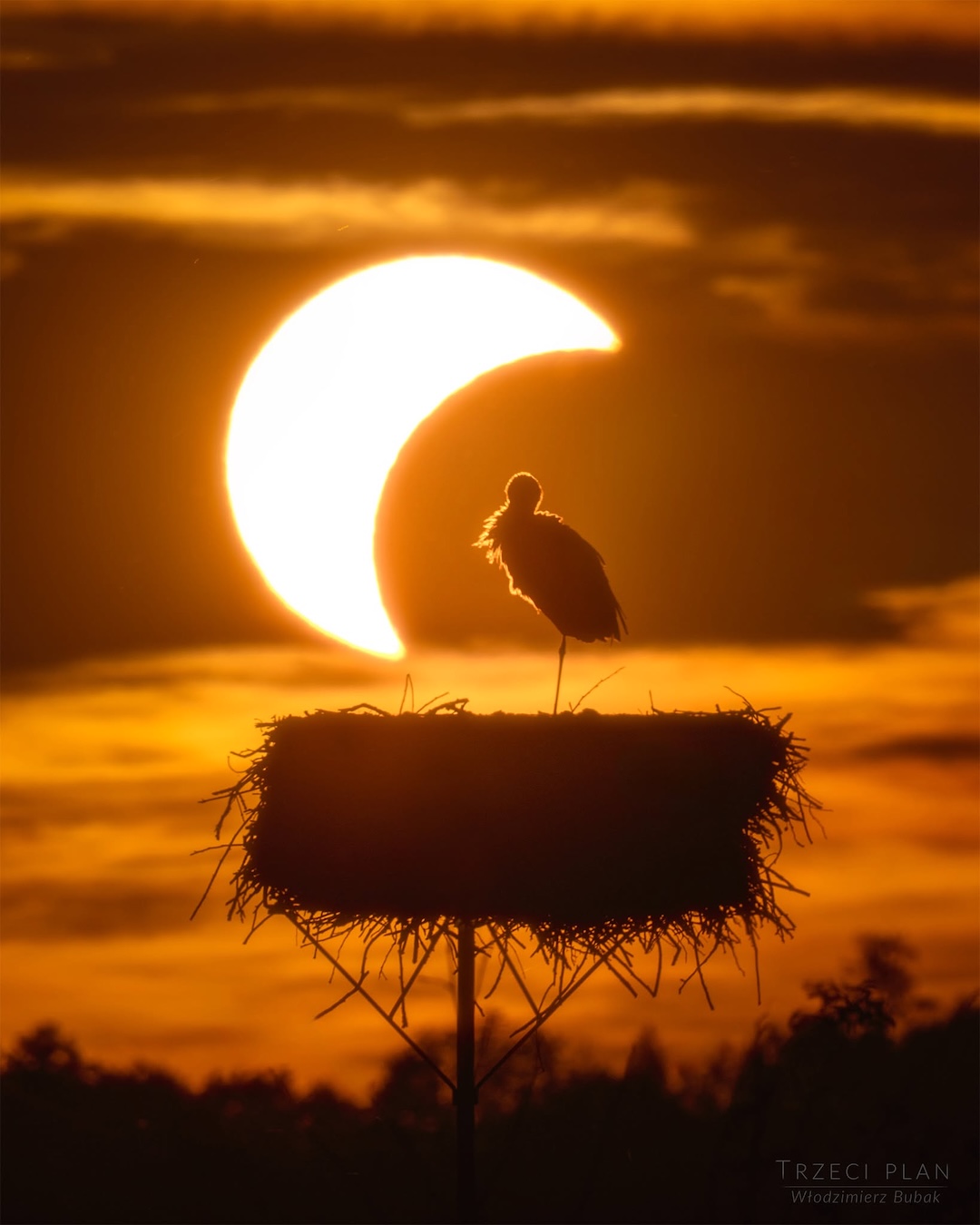
Look up and wonder. Today's cosmic highlight is The Eclipse and the Stork:
Why this matters
Today's view is a window onto the Moon, solar activity, the night sky. Images like this aren't just beautiful — they're how astronomers measure distance, motion and the deep history of the universe, turning faint light into hard data.
See it live on ObjectTracer
This connects to what you can track in real time on our 3D globe — explore Moon tracker · Solar System view · Deep Space. Or open the live globe to watch flights, satellites, the ISS and spacecraft move right now.
The science, from NASA's Astronomy Picture of the Day
How do animals react to a total solar eclipse? The featured image shows a stork roosting on her nest in Poland at a partial phase of the recent total solar eclipse. If you are lucky enough to experience a total eclipse somewhere quiet and close to nature, you may be able to notice unusual daytime animal behaviors. During totality, you may hear nighttime sounds like crickets and frogs and see fireflies. In the dark, most birds are quiet. Thinking that it is time to go to bed, ducks and other waterfowl prepare to sleep on one leg, with their heads turned around and their beaks tucked into their back feathers (they don't really sleep with their heads tucked under one wing). When sunlight returns at the end of totality, songbirds greet the new "morning" with their dawn songs. The crickets and frogs go quiet again. Animals and people resume their lifes, only briefly disturbed by the chance alignment of our Sun and Moon. APOD's main NASA site is moving : From apod.nasa.gov to science.nasa.gov/apod
Image credit: Włodzimierz Bubak Text: Cecilia Chirenti (NASA GSFC, UMCP, CRESST II) · Source: NASA APOD
More from the Space Journal
- Chasing the Moon's Shadow2026-09-05
- A Plane Lunar Eclipse2026-09-01
- Eclipse Pair2026-08-29
- The Pelican Nebula in Gas, Dust, and Stars2026-09-07
- Contemplating the Sun2026-08-09
- Launch of the Roman Space Telescope2026-08-31
← Solar Eclipses and Culture · Nā ʻUhane Māhoe Huki Pū i ke Ola →