2026-09-05
Chasing the Moon's Shadow
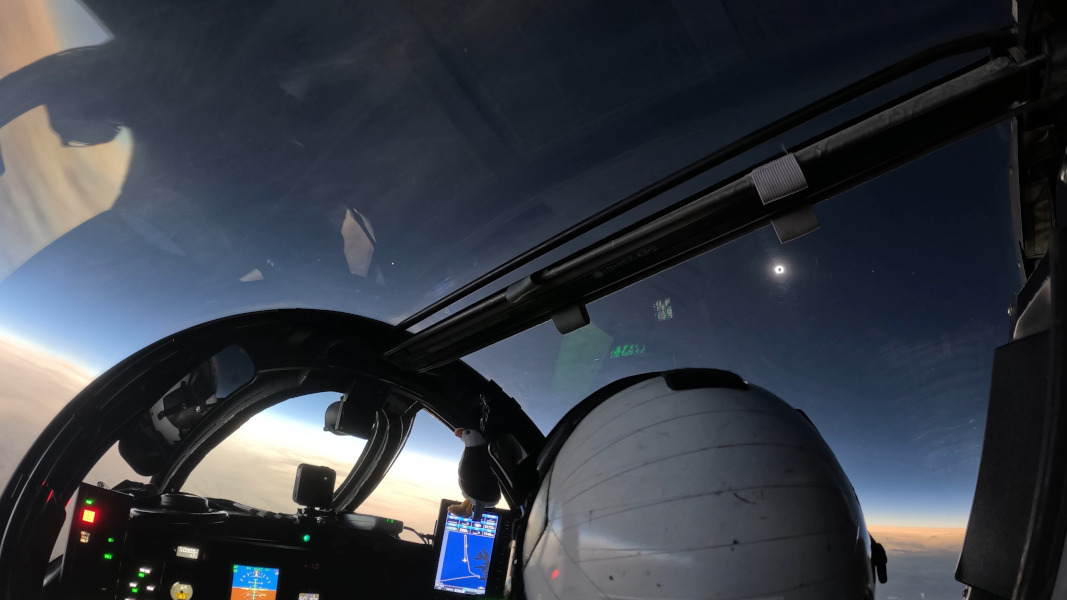
Space never stops amazing us. Today: Chasing the Moon's Shadow. Here is the science:
Why this matters
This scene highlights the Moon, solar activity, the night sky. The same physics that lets us photograph it also lets us predict where objects will be tomorrow — which is exactly what real-time tracking is built on.
See it live on ObjectTracer
This connects to what you can track in real time on our 3D globe — explore Moon tracker · Solar System view · Deep Space. Or open the live globe to watch flights, satellites, the ISS and spacecraft move right now.
The science, from NASA's Astronomy Picture of the Day
Chasing the shadow of a New Moon, NASA’s WB-57F high altitude research aircraft took to the skies off the coast of Iceland on August 12 to observe a total solar eclipse. At 50,000 feet the aircraft was piloted along the precisely determined path of totality to maximize its time in the Moon’s shadow. A suite of high-resolution cameras on board was able to record eclipse data from above the clouds, dust, and atmospheric water vapor that interfere with observations made closer to the ground. This view from the cockpit, taken from an inflight video, captures the solar corona emerging at the beginning of totality. The sky appears dark in the shadow of the Moon. Venus is shining left of center in the video frame, while Jupiter and Mercury are just visible to the right of the eclipsed Sun. But the sky is bright along the distant horizon below, beyond the reach of the Moon's shadow. APOD's main NASA site is moving: From apod.nasa.gov to science.nasa.gov/apod
Source: NASA Astronomy Picture of the Day (public domain)
More from the Space Journal
- Bright Perseids from Sweden2026-08-15
- Total Solar Eclipse from Greenland2026-08-14
- Perseids Over a little Planet2026-08-12
- Barnards Loop over Twin Volcanoes2026-07-28
- New Sharpest Image of the Sun Uncovers Instability2026-08-06
- Perseids from Perseus2026-08-18
← Nā ʻUhane Māhoe Huki Pū i ke Ola · Pluto in Enhanced Color →