2026-09-06
Pluto in Enhanced Color
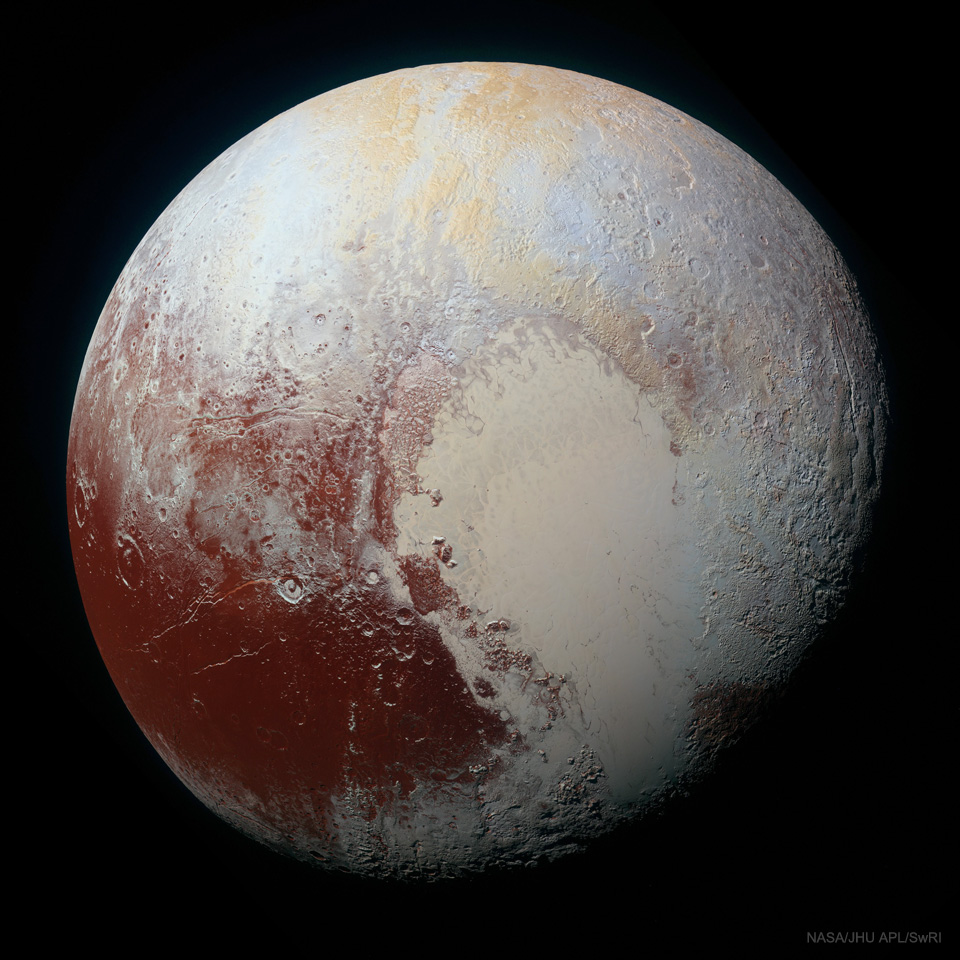
Today's window into deep space: Pluto in Enhanced Color. The story behind the image:
Why this matters
Behind the picture is the planets, near-Earth objects. Light that left these objects long ago is only reaching us now, which is why a single image can double as a snapshot of the distant past.
See it live on ObjectTracer
This connects to what you can track in real time on our 3D globe — explore Solar System view · Asteroid tracker. Or open the live globe to watch flights, satellites, the ISS and spacecraft move right now.
The science, from NASA's Astronomy Picture of the Day
Pluto is more colorful than we can see. Color data and high-resolution images of our Solar System's most famous dwarf planet, taken by the robotic New Horizons spacecraft during its flyby in 2015 July, have been digitally combined to give an enhanced-color view of this ancient world sporting an unexpectedly young surface. The featured enhanced color image is not only esthetically pretty but scientifically useful, making surface regions of differing chemical composition visually distinct. For example, the light-colored heart-shaped Tombaugh Regio on the lower right is clearly shown here to be divisible into two regions that are geologically different, with the leftmost lobe, Sputnik Planitia, also appearing unusually smooth. After Pluto, New Horizons continued on, shooting past asteroid Arrokoth in 2019 with enough speed to escape our Solar System completely.
Source: NASA Astronomy Picture of the Day (public domain)
More from the Space Journal
- Comet 220P in Outburst2026-08-24
- Bright Perseids from Sweden2026-08-15
- Perseids Over a little Planet2026-08-12
- Contemplating the Sun2026-08-09
- The Elephant's Trunk in Cepheus2026-08-20
- M74: A Grand Design Spiral2026-08-30
← Chasing the Moon's Shadow · The Pelican Nebula in Gas, Dust, and Stars →