2026-08-24
Comet 220P in Outburst
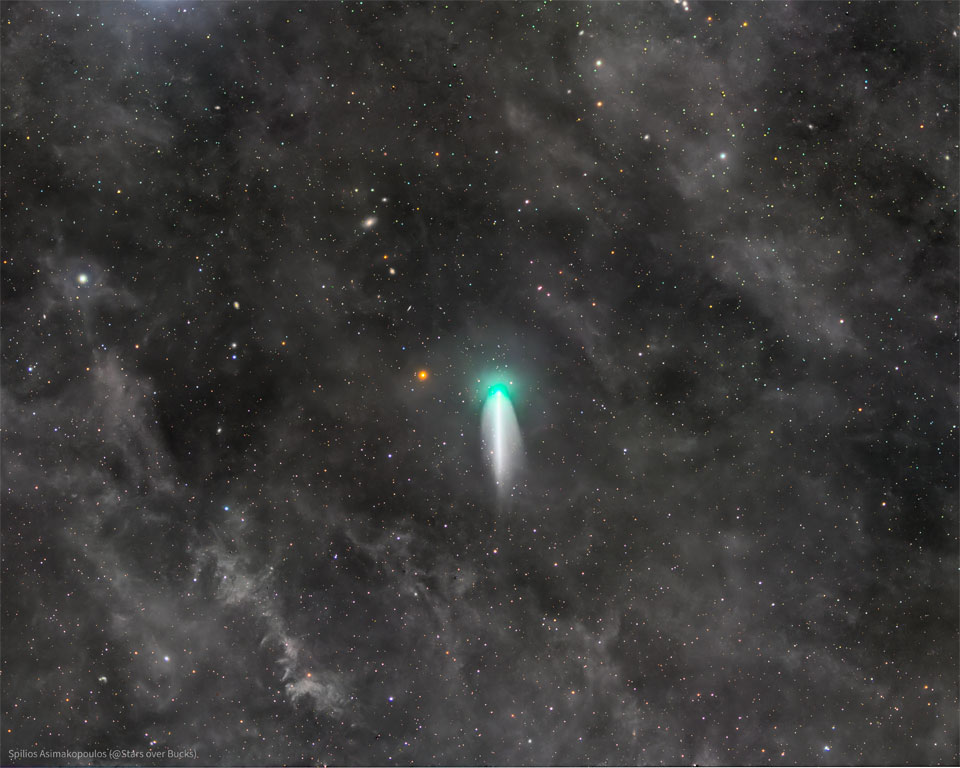
Look up and wonder. Today's cosmic highlight is Comet 220P in Outburst:
Why this matters
This scene highlights the planets, near-Earth objects, the night sky. The same physics that lets us photograph it also lets us predict where objects will be tomorrow — which is exactly what real-time tracking is built on.
See it live on ObjectTracer
This connects to what you can track in real time on our 3D globe — explore Solar System view · Asteroid tracker · Deep Space. Or open the live globe to watch flights, satellites, the ISS and spacecraft move right now.
The science, from NASA's Astronomy Picture of the Day
Comet 220P is unexpectedly bright. Normally, periodic Comet 220P/McNaught is so dim that to see it requires a telescope. Two surprising outbursts this year, however, have made it about 20,000 times brighter than usual, so that it is now visible with binoculars and long-duration camera exposures. As expected, Comet 220P continues to orbit the Sun between Mars and Jupiter with a period of over 5 years. The featured long duration exposure, taken 10 days ago from South Africa, shows the comet's bright green head and short dust tail. Reasons for Comet 220P's impressive outbursts are unknown but could be caused by the release of built-up subsurface gas or comet quakes. Comet 220P will pass about one Earth-Sun distance from the Earth in October, after which it is expected to fade quickly as it begins its return to the far part of its orbit. APOD's main NASA site is moving : From apod.nasa.gov to science.nasa.gov/apod
Image credit: Spilios Asimakopoulos · Source: NASA APOD
More from the Space Journal
- Bright Perseids from Sweden2026-08-15
- Perseids Over a little Planet2026-08-12
- Spokes on Saturn's B Ring2026-08-05
- A Messier Moment for Tempel 22026-08-08
- Psyche Receives Gravity Assist from Mars2026-07-29
- Hubble: Decagon Around Saturn's South Pole2026-09-08
← Cassini Approaches Saturn · Earth's Shadow Visualized with Lunar Eclipses →