2026-08-08
A Messier Moment for Tempel 2
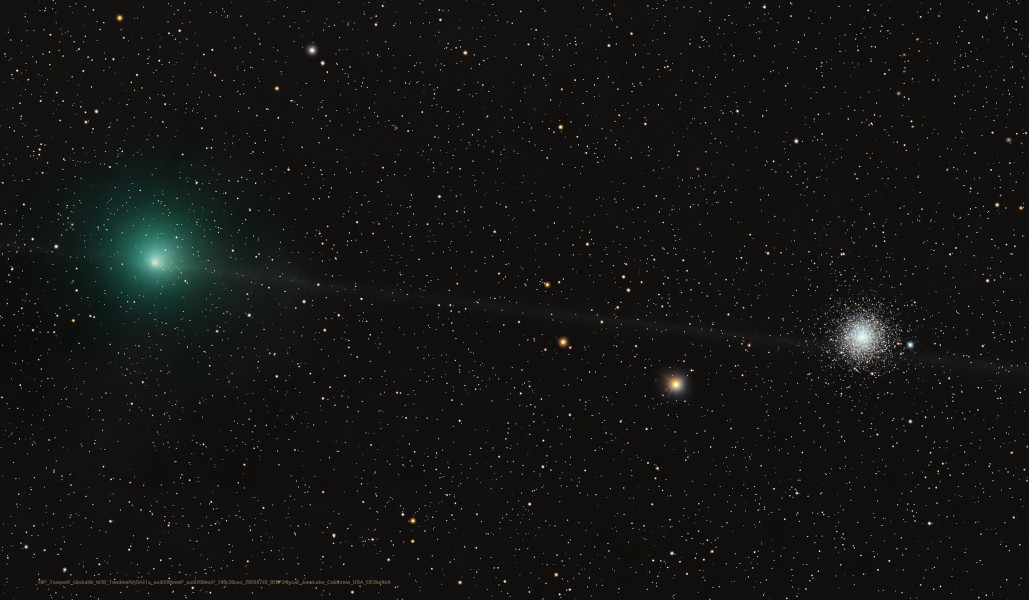
Space never stops amazing us. Today: A Messier Moment for Tempel 2. Here is the science:
Why this matters
Today's highlight centers on deep-space objects, near-Earth objects. Understanding how these objects form and move is the bridge between a pretty photo and the live, data-driven sky we render on the globe.
See it live on ObjectTracer
This connects to what you can track in real time on our 3D globe — explore Deep Space galaxy map · Asteroid tracker. Or open the live globe to watch flights, satellites, the ISS and spacecraft move right now.
The science, from NASA's Astronomy Picture of the Day
Which of these is not a comet? You guessed it - the one on the right is a globular star cluster. The diffuse greenish coma of periodic comet 10P/Tempel 2 is at left in the frame. In fact the globular star cluster is Messier 30, also known as M30, or the 30th entry in astronomer Charles Messier's catalog of things which are not comets. The well-known 18th century astronomer kept a list of objects he observed, now his famous Messier Catalogue of Nebulae and Star Clusters, which did not move from night to night against the background stars and so were not the comets he was hunting for. So the famous comet hunter would get the correct answer too, even though his telescope would show both 10P/Tempel 2 and distant star cluster as similar looking faint and fuzzy objects in his field of view. Recorded on July 29, this modern telescopic image captures periodic comet Tempel 2 as it briefly swept close on the sky to M30. While the periodic comet's faint, narrow, orbital dust trail seems to pierce the globular star cluster, Tempel 2 was a mere 3.5 light-minutes away. Messier 30 is some 28,000 light-years distant.
Image credit: Dan Bartlett · Source: NASA APOD
More from the Space Journal
- Perseids Over a little Planet2026-08-12
- Curious Cometary Knots in the Helix Nebula2026-08-04
- Vaporizing Meteor Photobombs the Lacerta Nebula2026-08-03
- Pluto in Enhanced Color2026-09-06
- Total Solar Eclipse from Greenland2026-08-14
- Nā ʻUhane Māhoe Huki Pū i ke Ola2026-09-04