2026-09-08
Hubble: Decagon Around Saturn's South Pole
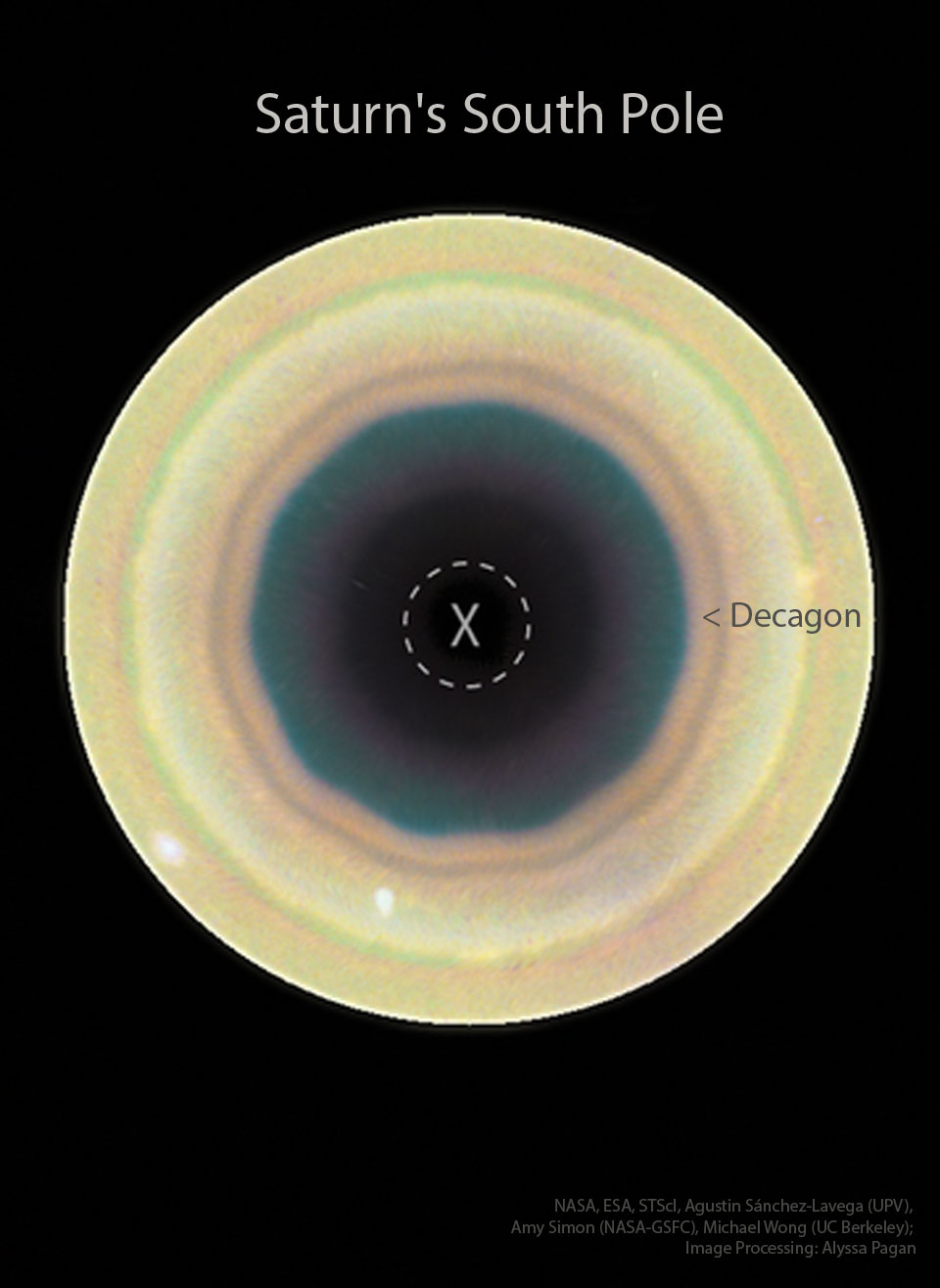
Today's window into deep space: Hubble: Decagon Around Saturn's South Pole. The story behind the image:
Why this matters
Today's view is a window onto the planets. Images like this aren't just beautiful — they're how astronomers measure distance, motion and the deep history of the universe, turning faint light into hard data.
See it live on ObjectTracer
This connects to what you can track in real time on our 3D globe — explore Solar System view. Or open the live globe to watch flights, satellites, the ISS and spacecraft move right now.
The science, from NASA's Astronomy Picture of the Day
Why are Saturn’s poles geometric? Saturn’s North Pole has been known to be surrounded by a hexagonal (6 sides) cloud since discovery in 1987 in data taken by NASA’s Voyager spacecrafts, which quickly flew past the ringed world in the early 1980s. Now, recent observations of Saturn by the Hubble Space Telescope reveal a slightly different geometric cloud pattern around the South Pole: a decagon (10 sides). The geometric boundaries are possibly caused by waves when the fast-moving gas away from the poles interacts with slower-moving gas closer to the poles. In the featured image composite by the Hubble taken last year, the South Pole of Saturn is marked by an X and surrounded by bands of circulating clouds. The decagon appears most prominent in the dark inner regions. The northern hexagon has proven stable for over 40 years, while the stability of the southern decagon will surely remain a topic of research. APOD's main NASA site is moving: From apod.nasa.gov to science.nasa.gov/apod
Source: NASA Astronomy Picture of the Day (public domain)
More from the Space Journal
- Pluto in Enhanced Color2026-09-06
- Chasing the Moon's Shadow2026-09-05
- Launch of the Roman Space Telescope2026-08-31
- Apollo 11: Catching Some Sun2026-09-12
- Comet 220P in Outburst2026-08-24
- Six Moons of Saturn2026-08-11
← The Pelican Nebula in Gas, Dust, and Stars · Witness XZ Andromedae Wink →