2026-08-18
Perseids from Perseus
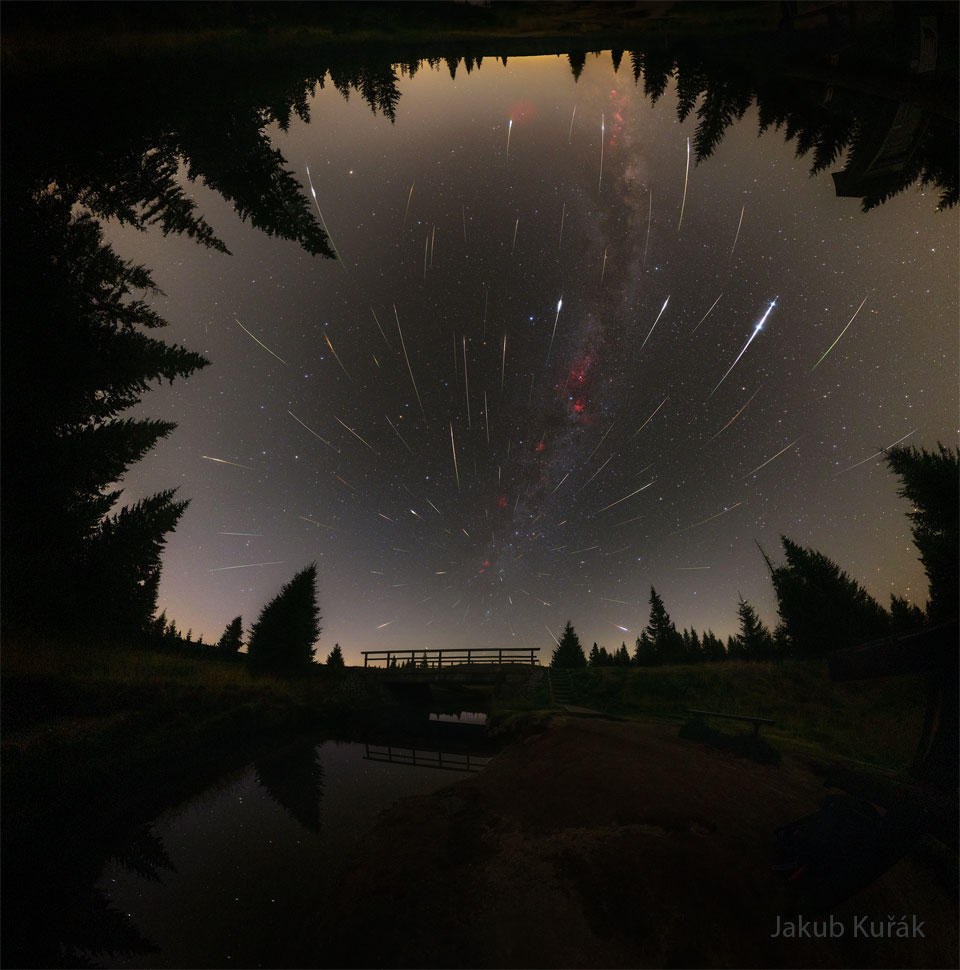
A fresh look at our universe: Perseids from Perseus. NASA's take:
Why this matters
Today's view is a window onto the Moon, solar activity, near-Earth objects. Images like this aren't just beautiful — they're how astronomers measure distance, motion and the deep history of the universe, turning faint light into hard data.
See it live on ObjectTracer
This connects to what you can track in real time on our 3D globe — explore Moon tracker · Solar System view · Asteroid tracker. Or open the live globe to watch flights, satellites, the ISS and spacecraft move right now.
The science, from NASA's Astronomy Picture of the Day
This was a good year for the Perseids meteor shower. A key reason was the Moon was absent from lighting up Earth's night sky so that more meteors were visible than usual. Where was the Moon? It was busy visiting the Sun. Near the Perseids peak, the Moon moved directly in front of the Sun and created a total solar eclipse visible from Greenland and Spain. The Perseids occur when the Earth collides with a stream of Sun-orbiting debris cast off by Comet Swift-Tuttle. Perseid meteors, although typically only the size of a sand grain, tend to be fast and bright because Swift-Tuttle's debris orbits the Sun in a direction partly opposite Earth's orbital motion. In the featured image compilation, accumulated over several nights from Jizerka in the Czech Republic, the Perseids meteor streaks can be traced back to a single location on the sky -- its radiant in Perseus. Gallery: Perseids Meteor Shower of 2026
Image credit: Jakub Kuřák · Source: NASA APOD
More from the Space Journal
- Bright Perseids from Sweden2026-08-15
- Perseids Over a little Planet2026-08-12
- Contemplating the Sun2026-08-09
- The Pelican Nebula in Gas, Dust, and Stars2026-09-07
- Launch of the Roman Space Telescope2026-08-31
- Comet 220P in Outburst2026-08-24
← A Golden Corona Eclipse · The Case of the Mysterious Maybe Meteor →