2026-07-14
Double Lobed Asteroid Torifune
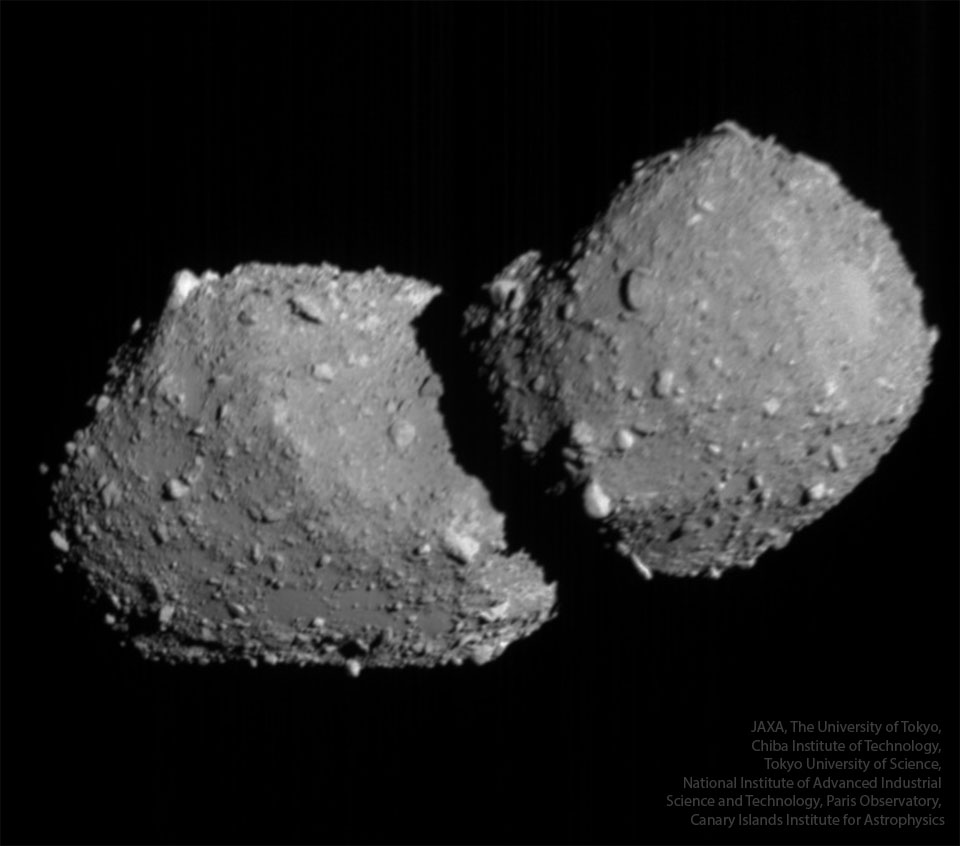
Another stunning view from the cosmos: Double Lobed Asteroid Torifune. NASA explains:
Why this matters
Today's view is a window onto near-Earth objects, the night sky. Images like this aren't just beautiful — they're how astronomers measure distance, motion and the deep history of the universe, turning faint light into hard data.
See it live on ObjectTracer
This connects to what you can track in real time on our 3D globe — explore Asteroid tracker · Deep Space. Or open the live globe to watch flights, satellites, the ISS and spacecraft move right now.
The science, from NASA's Astronomy Picture of the Day
Why is this asteroid a double? Earlier this month the Japanese robotic spacecraft Hayabusa2 shot past asteroid 98943 Torifune and captured pictures. Although previous observations from distant Earth indicated that Torifune was oblong, Hayabusa2 found that Torifune actually has two joined lobes. With a length of about four soccer fields, this space rock frequently comes near the Earth as it orbits the Sun, although it is not a threat. Besides the two lobes, Torifune shows many large boulders, but, surprisingly, no obvious craters, likely because its surface is a pile of rubble. Like asteroid Arrokoth, it appears that each lobe formed separately before colliding and becoming stuck together. Hayabusa2 famously encountered asteroid Ryugu in 2018, and now heads for an encounter in 2031 with 1998 KY26, a smaller asteroid that rotates unusually fast and might have reservoirs of ice.
Image credit: JAXA, U. of Tokyo, Chiba Tech, Tokyo U. of Science, AIST, Paris Obs., IAC · Source: NASA APOD
More from the Space Journal
- Dueling Bands over the Atacama Desert2026-07-06
- The Cotton Candy Clouds of Rho Ophiuchi2026-07-01
- M27: The Dumbbell Nebula2026-06-22
- Andromeda Through Gas and Dust2026-06-03
- Starry Night II2026-06-19
- Swift Boost Mission2026-07-08