2026-07-15
Red Sprites in the Tatacoa Desert
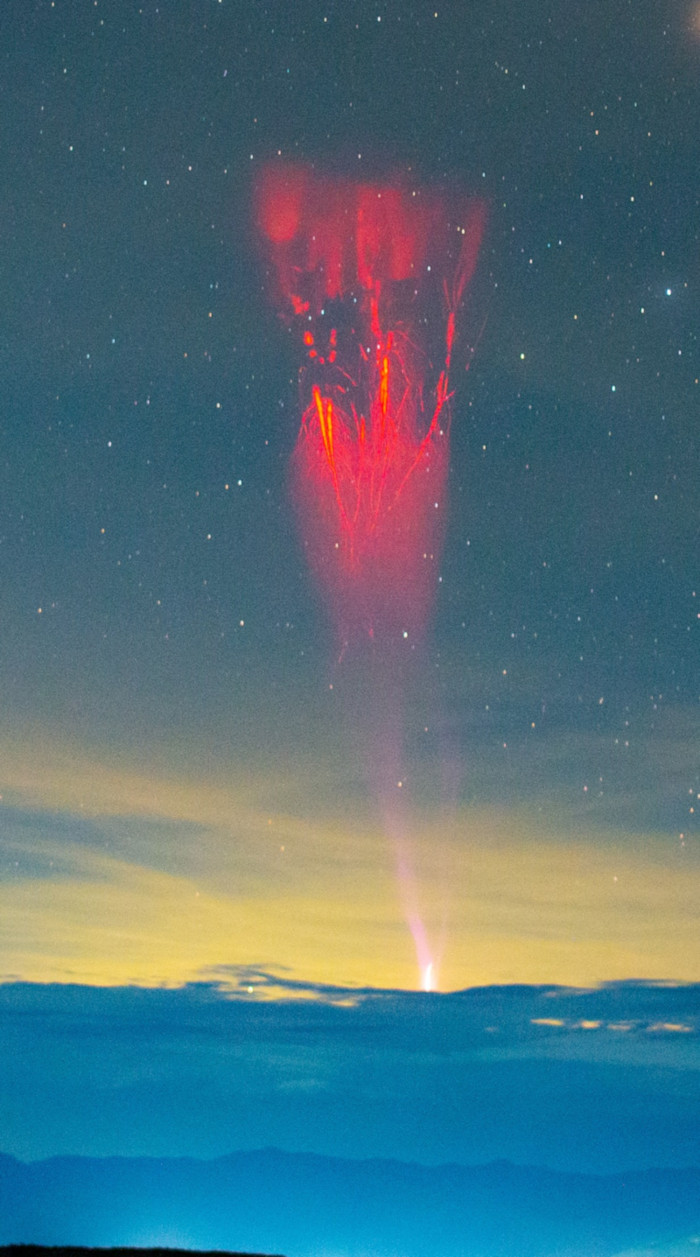
Today's window into deep space: Red Sprites in the Tatacoa Desert. The story behind the image:
Why this matters
What you're looking at ties directly to the planets. Every frame the world's observatories capture adds another data point to humanity's slowly-assembling map of everything beyond our planet.
See it live on ObjectTracer
This connects to what you can track in real time on our 3D globe — explore Solar System view. Or open the live globe to watch flights, satellites, the ISS and spacecraft move right now.
The science, from NASA's Astronomy Picture of the Day
Is there an angry Sith using force lightning in the Tatacoa Desert? This is not science fiction, but a red sprite with multiple streamers! Ordinary lightning occurs when thundercloud particles collide, lose their electrons, and build up negative charge at the cloud bottom. The cloud’s negative charge repels negative charge deeper into the Earth, leaving Earth’s surface positively charged. The opposite charges attract, reaching towards each other and superheating the air into a white strike of plasma. Red sprites are millisecond events triggered by positive cloud-to-ground lightning. They extend up into the mesosphere where the air is too thin for thunder. Their red glow comes from heated molecular nitrogen. There are several potential causes for red sprites, including that the preceding positive lightning exposes the negatively charged cloud core to the positively charged upper atmosphere, allowing those charges to connect. NASA’s Juno has observed sprites on Jupiter, indicating that sprites occur on other planets!
Image credit: Mario Vargas Text: Keighley Rockcliffe (NASA GSFC, UMBC CSST, CRESST II) · Source: NASA APOD
More from the Space Journal
- Dueling Bands over the Atacama Desert2026-07-06
- Saturn's Iapetus: Painted Moon2026-07-05
- Pathfinder on Mars2026-07-04
- Messier 1042026-05-29
- Interplanetary Earth2026-06-13
- AR 4478: Giant Sunspot Group2026-06-28