2026-08-02
A Fire Rainbow over West Virginia
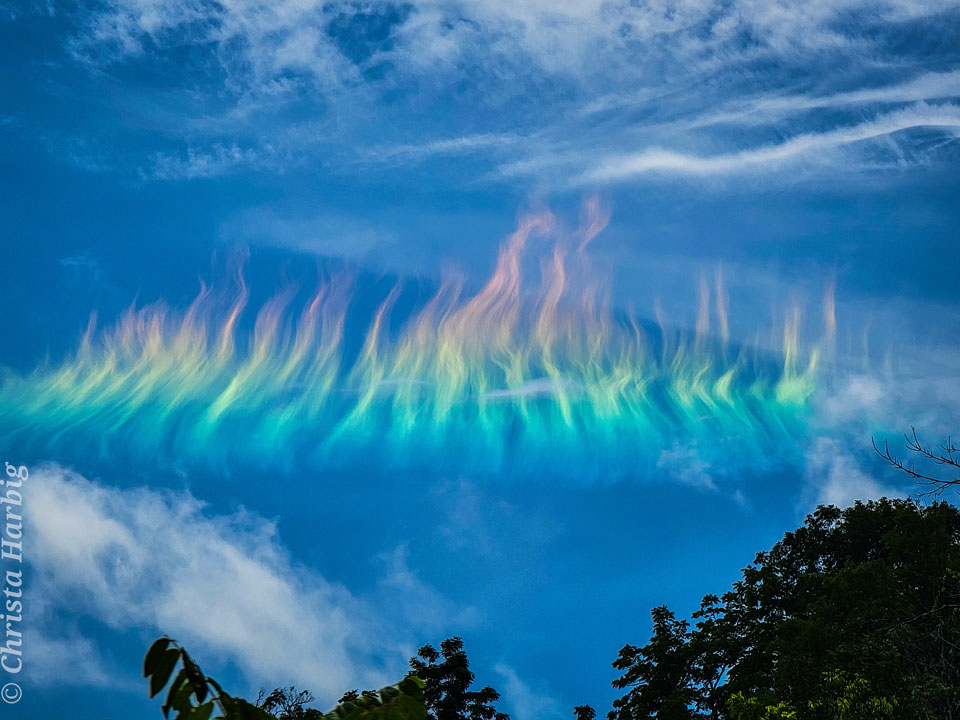
Another stunning view from the cosmos: A Fire Rainbow over West Virginia. NASA explains:
Why this matters
Behind the picture is the night sky. Light that left these objects long ago is only reaching us now, which is why a single image can double as a snapshot of the distant past.
See it live on ObjectTracer
This connects to what you can track in real time on our 3D globe — explore Deep Space. Or open the live globe to watch flights, satellites, the ISS and spacecraft move right now.
The science, from NASA's Astronomy Picture of the Day
What's happening to this cloud? Ice crystals in a distant cirrus cloud are acting like little floating prisms. Known informally as a fire rainbow for its flame-like appearance, a circumhorizon arc appears parallel to the horizon. For a circumhorizontal arc to be visible, the Sun must be at least 58 degrees high in a sky where cirrus clouds present below -- in this case cirrus fibratus. The numerous, flat, hexagonal ice-crystals that compose the cirrus cloud must be aligned horizontally to properly refract sunlight in a collectively similar manner. Therefore, circumhorizontal arcs are somewhat unusual to see. The featured fire rainbow was photographed in 2021 near North Fork Mountain in West Virginia, USA. Sky Surprise: What picture did APOD feature on your birthday? (after 1995)
Image credit: Christa Harbig · Source: NASA APOD
More from the Space Journal
- Webb's View of M642026-09-16
- A Daytime Eclipse: Moon Occults Venus2026-09-15
- Where Your Elements Came From2026-09-14
- LDN 1295: The Giraffe Nebula2026-09-10
- Milky Way over Yellowstone2026-08-16
- Nā ʻUhane Māhoe Huki Pū i ke Ola2026-09-04
← Buck Moon and Belt of Venus · Vaporizing Meteor Photobombs the Lacerta Nebula →