2026-08-10
Three Galaxy Pairs
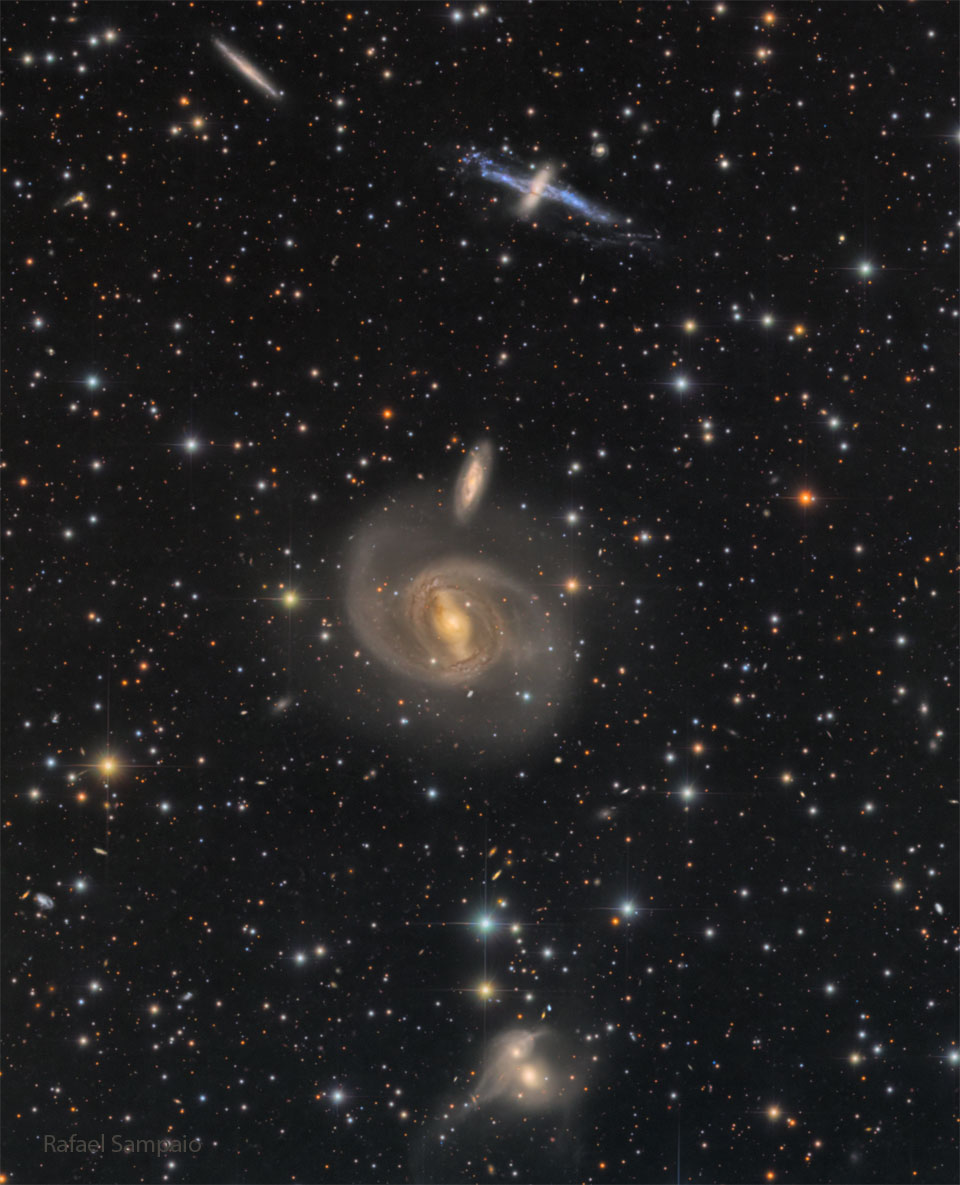
The universe showed off again today: Three Galaxy Pairs. Here is what NASA captured:
Why this matters
This scene highlights deep-space objects. The same physics that lets us photograph it also lets us predict where objects will be tomorrow — which is exactly what real-time tracking is built on.
See it live on ObjectTracer
This connects to what you can track in real time on our 3D globe — explore Deep Space galaxy map. Or open the live globe to watch flights, satellites, the ISS and spacecraft move right now.
The science, from NASA's Astronomy Picture of the Day
ch of these pairs of galaxies is different. The two galaxies at the top are likely not interacting, at least presently. However, the top galaxy with the blue stripe, NGC 4650A, is a polar ring galaxy and may be the result of a past galaxy collision. The two galaxies in the middle of the featured image appear like they could be interacting gravitationally -- but their relative speeds make this unlikely. Of these two, the larger galaxy, NGC 4650, is a spiral galaxy with a bright bar of stars across its center. The two galaxies at the bottom are actively interacting. Possibly in a billion years or so, NGC 4622A and NGC 4622B will merge and become one single galaxy. All of these galaxies are likely members of the larger Centaurus Galaxy Cluster. Explore the Universe: Random APOD Generator
Image credit: Rafael Sampaio · Source: NASA APOD
More from the Space Journal
- M83: The Southern Pinwheel2026-09-11
- LDN 1295: The Giraffe Nebula2026-09-10
- Witness XZ Andromedae Wink2026-09-09
- Vaporizing Meteor Photobombs the Lacerta Nebula2026-08-03
- Bright Perseids from Sweden2026-08-15
- Comet 220P in Outburst2026-08-24