2026-09-19
A Zodiacal Night
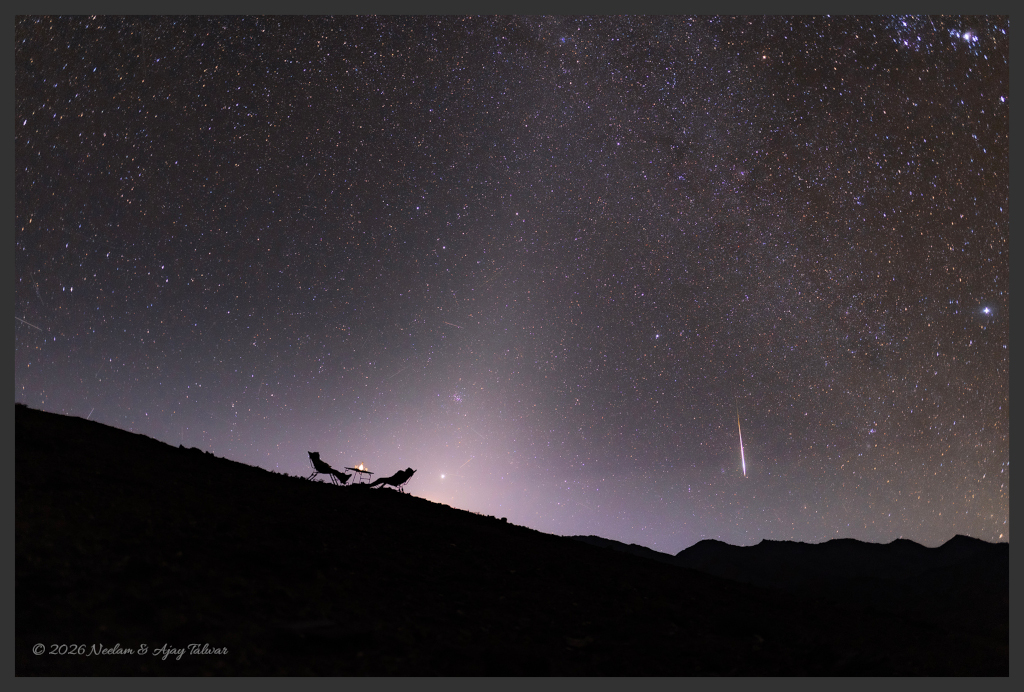
Today's window into deep space: A Zodiacal Night. The story behind the image:
Why this matters
This scene highlights deep-space objects, the planets, near-Earth objects. The same physics that lets us photograph it also lets us predict where objects will be tomorrow — which is exactly what real-time tracking is built on.
See it live on ObjectTracer
This connects to what you can track in real time on our 3D globe — explore Deep Space galaxy map · Solar System view · Asteroid tracker. Or open the live globe to watch flights, satellites, the ISS and spacecraft move right now.
The science, from NASA's Astronomy Picture of the Day
Also known as the false dawn, a luminous band of zodiacal light is captured in this dark night skyscape. The serene view was recorded just before the beginning of astronomical twilight during September's star party at the remote Hanle Dark Sky Reserve, Ladakh, India, planet Earth. At about 4,500 meters altitude, the dark sky reserve presents a haven for hardy stargazing and astrophotography enthusiasts. While meteors streak through the night, bright planet Jupiter appears immersed in the faint zodiacal glow near the eastern horizon. Follow the zodiacal band toward the zenith to find open star cluster M44 and a yellowish tinged planet Mars near the center of the frame. In fact, serendipitous detections of interplanetary dust by NASA's Juno spacecraft suggest Mars itself is the source of dust that back scatters sunlight and creates zodiacal light in planet Earth's night. APOD's main NASA site is moving: From apod.nasa.gov to science.nasa.gov/apod
Image credit: Neelam and Ajay Talwar · Source: NASA APOD
More from the Space Journal
- Perseids Over a little Planet2026-08-12
- Curious Cometary Knots in the Helix Nebula2026-08-04
- Witness XZ Andromedae Wink2026-09-09
- The Case of the Mysterious Maybe Meteor2026-08-19
- A Daytime Eclipse: Moon Occults Venus2026-09-15
- JWST Images The Lion's Head Nebula2026-08-26