2026-06-12
Venus and Jupiter: Conjunction from Avebury
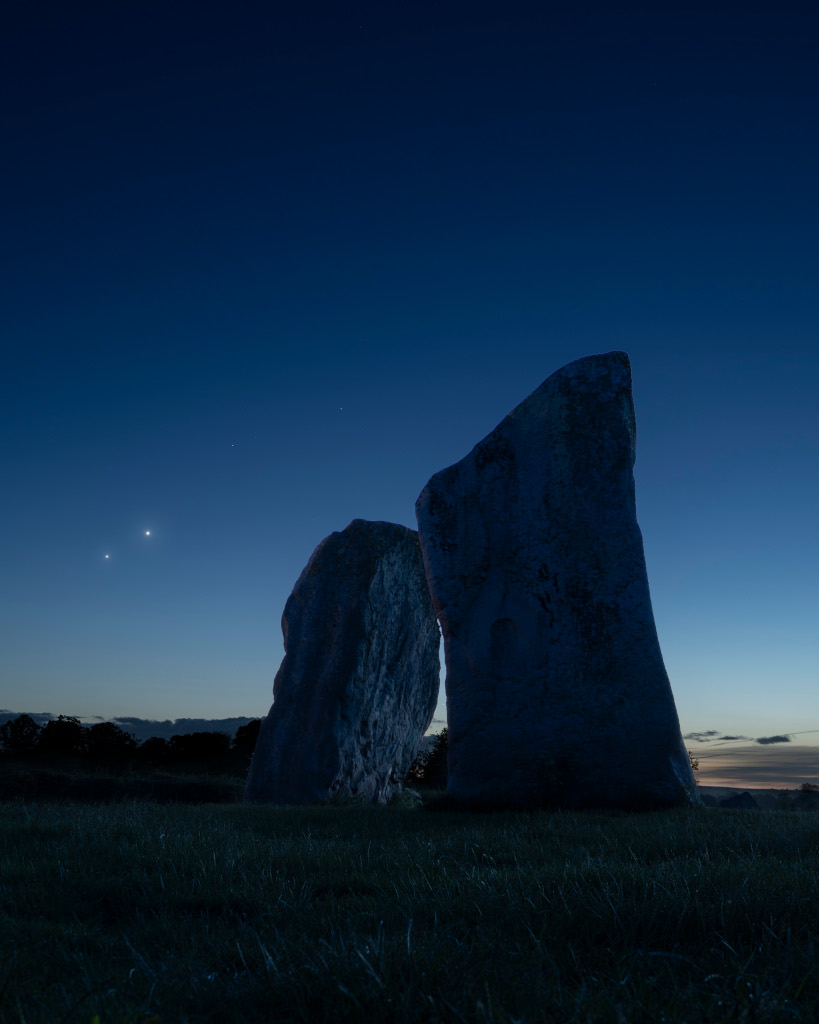
The universe showed off again today — Venus and Jupiter: Conjunction from Avebury. Here is what NASA captured:
Why this matters
This scene highlights deep-space objects, the planets. The same physics that lets us photograph it also lets us predict where objects will be tomorrow — which is exactly what real-time tracking is built on.
See it live on ObjectTracer
This connects to what you can track in real time on our 3D globe — explore Deep Space galaxy map · Solar System view. Or open the live globe to watch flights, satellites, the ISS and spacecraft move right now.
The science, from NASA's Astronomy Picture of the Day
To see Venus and Jupiter together this month, you won't need binoculars or even a telescope. Just look up after sunset and you'll find them emerging as the sky grows dark near the western horizon. In fact, on June 9 the two brightest planets were in close conjunction, separated on the sky by less than 2 degrees from our perspective. Since (brighter) inner planet Venus orbits the Sun faster than outer planet Jupiter, it catches up with and passes the outer planet along the ecliptic roughly every 13 months. But every three years or so their resulting conjunction can be viewed far enough from the Sun to be easily seen in Earth's twilight skies. On June 9, the two celestial beacon's close "cosmic kiss" was captured here next to the two large standing stones at the cove within a 4,000 year old stone circle at Avebury, UK. Larger than Stonehenge, the Avebury henge and stone circle complex is also recognized as one of the most significant neolithic ceremonial sites on planet Earth.
Image credit: Josh Dury · Source: NASA APOD
More from the Space Journal
- Dueling Bands over the Atacama Desert2026-07-06
- The Cotton Candy Clouds of Rho Ophiuchi2026-07-01
- M27: The Dumbbell Nebula2026-06-22
- AR 4478: Giant Sunspot Group2026-06-28
- Sibling Supernova Remnants2026-07-02
- Saturn's Iapetus: Painted Moon2026-07-05
← The Mermaid Nebula Supernova Remnant · Interplanetary Earth →