2026-06-11
The Mermaid Nebula Supernova Remnant
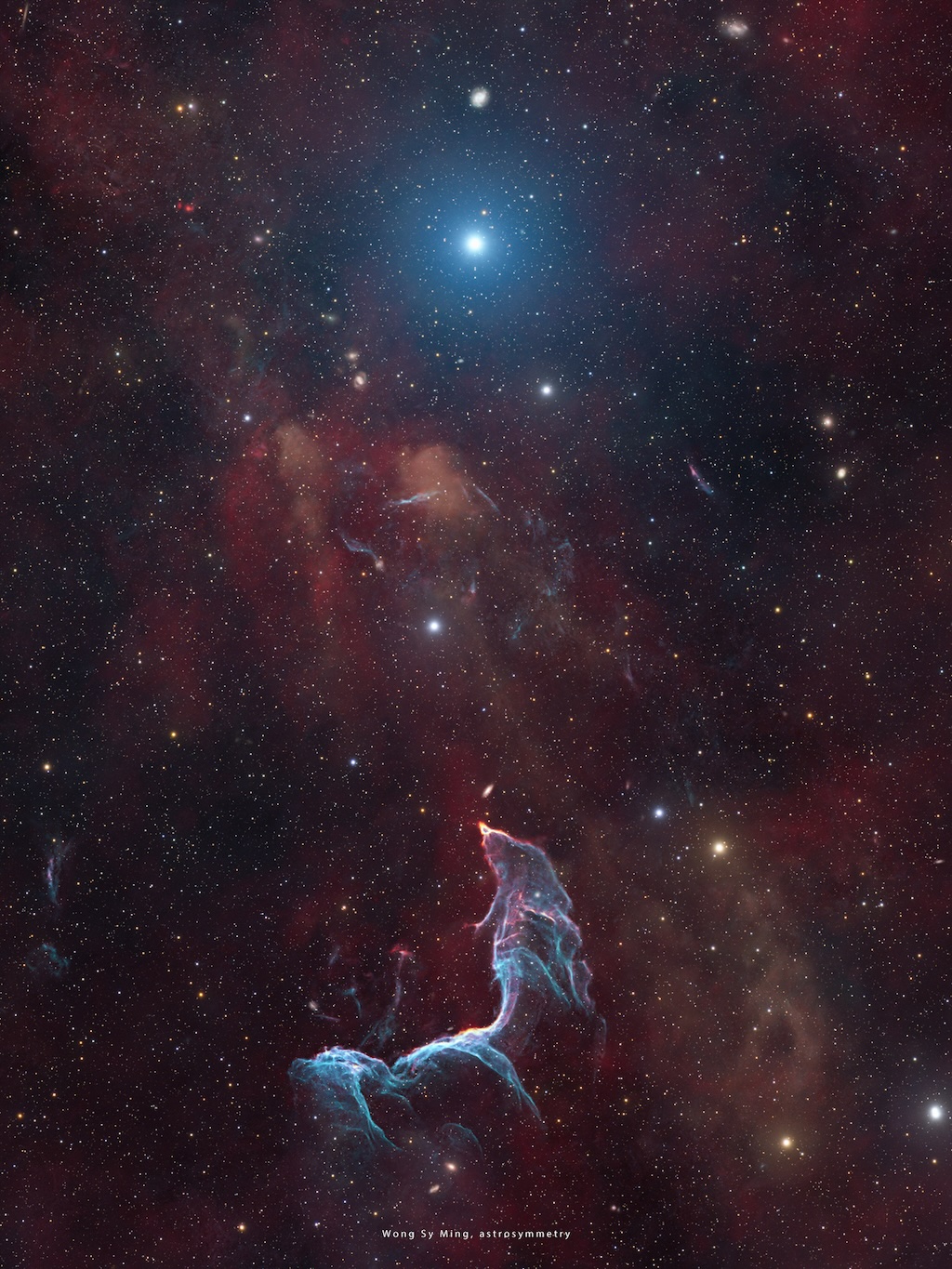
Space never stops amazing us. Today: The Mermaid Nebula Supernova Remnant. Here is the science:
Why this matters
What you're looking at ties directly to deep-space objects. Every frame the world's observatories capture adds another data point to humanity's slowly-assembling map of everything beyond our planet.
See it live on ObjectTracer
This connects to what you can track in real time on our 3D globe — explore Deep Space galaxy map. Or open the live globe to watch flights, satellites, the ISS and spacecraft move right now.
The science, from NASA's Astronomy Picture of the Day
Could the Little Mermaid turn into stardust instead of seafoam? It would seem so in this beautiful nebula. The featured image shows the Mermaid Nebula, also known as the Betta Fish Nebula, which is part of the G296.5+10.0 Supernova Remnant. The blue color visible here originates from doubly ionized oxygen (OIII), while the deep red is emitted by hydrogen gas. Estimated to be located a few thousand light-years away and about 10,000 years old, this nebula was formed when a massive star exploded as a supernova. It left behind a peculiar pulsar, a young radio-quiet neutron star that spins around about twice every second. The bright stars shown in the image are unassociated with the nebula. The pulsar can be detected in the X-rays but it does not have a confirmed detection in the optical (visible light) so far. As a result, the pulsar itself is not visible in this image.
Image credit: Data acquisition: Sy Ming Wong; Processing: Guangyan Gao Text: Cecilia Chirenti (NASA GSFC, UMCP, CRESST II) · Source: NASA APOD
More from the Space Journal
- Simulation TNG50: A Galaxy Cluster Forms2026-07-26
- RCW 86: Historical Supernova Remnant2026-07-24
- The Large Magellanic Cloud2026-07-23
- Starry Night II2026-06-19
- Unusually Smooth Sections of Asteroid Itokawa2026-06-30
- Messier 24: Sagittarius Star Cloud2026-07-11
← The Eagle Nebula and Friends · Venus and Jupiter: Conjunction from Avebury →