2026-06-10
The Eagle Nebula and Friends
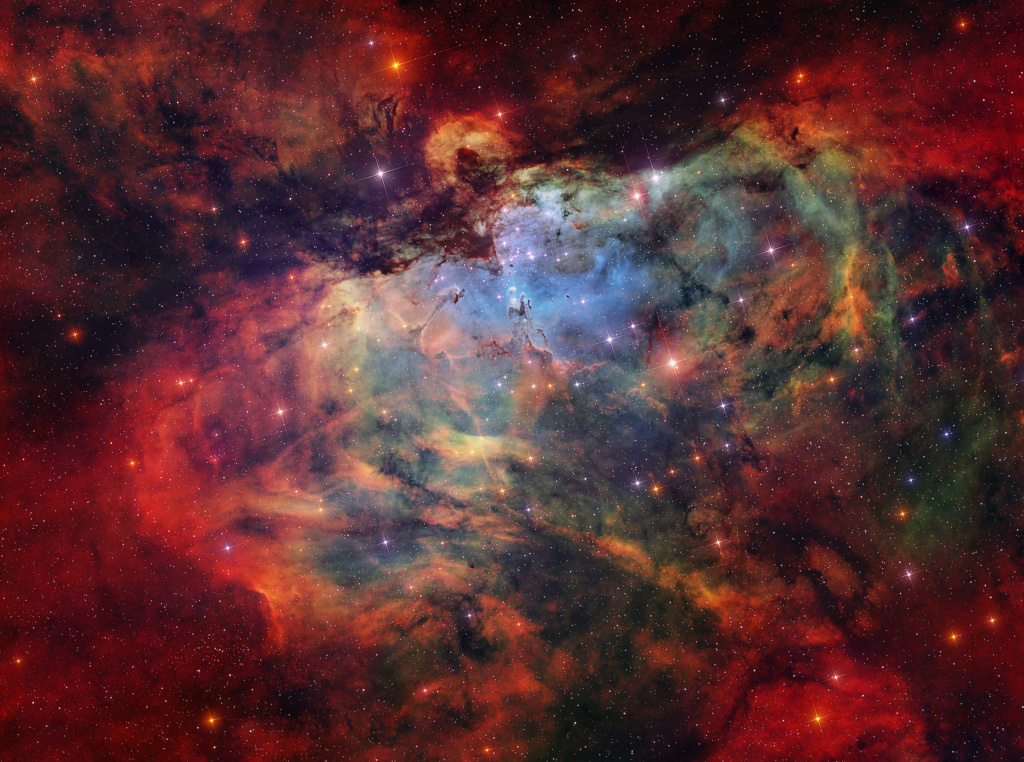
A fresh look at our universe — The Eagle Nebula and Friends. NASA's take:
Why this matters
Today's view is a window onto deep-space objects. Images like this aren't just beautiful — they're how astronomers measure distance, motion and the deep history of the universe, turning faint light into hard data.
See it live on ObjectTracer
This connects to what you can track in real time on our 3D globe — explore Deep Space galaxy map. Or open the live globe to watch flights, satellites, the ISS and spacecraft move right now.
The science, from NASA's Astronomy Picture of the Day
What looks as if it is going to swallow the great Pillars of Creation? The Eagle Nebula (M16) is not a bird, a plane, or Superman. M16 is actually a combination of several celestial objects. NGC 6611 is the young star cluster that appears to peak out beneath the Eagle’s “wings”. The ultraviolet light from these stars ionizes the surrounding gas, creating the emission nebula IC 4703. The Stellar Spire is seen reaching towards the Pillars of Creation from the left. Both are structures of cold gas and dust that are optimal for star formation. Some astronomers previously thought the Pillars of Creation had been evaporated away by a supernova. Because M16 is 6,000 light years away, we would not be able to see the Pillars’ destruction for thousands more years. However, there is no conclusive evidence of the theorized supernova, so the Pillars of Creation will likely continue to create stars for millions of years.
Image credit: Emmanuel Delgadillo Text: Keighley Rockcliffe (NASA GSFC, UMBC CSST, CRESST II) · Source: NASA APOD
More from the Space Journal
- RCW 86: Historical Supernova Remnant2026-07-24
- The Large Magellanic Cloud2026-07-23
- The Corona Australis Molecular Cloud and the Chandelier Cluster2026-07-22
- Keogram: The Sky in 20252026-06-21
- NGC 300: A Cosmic Gemstone with Stars and Gas Clouds2026-07-16
- The Cotton Candy Clouds of Rho Ophiuchi2026-07-01