2026-06-21
Keogram: The Sky in 2025
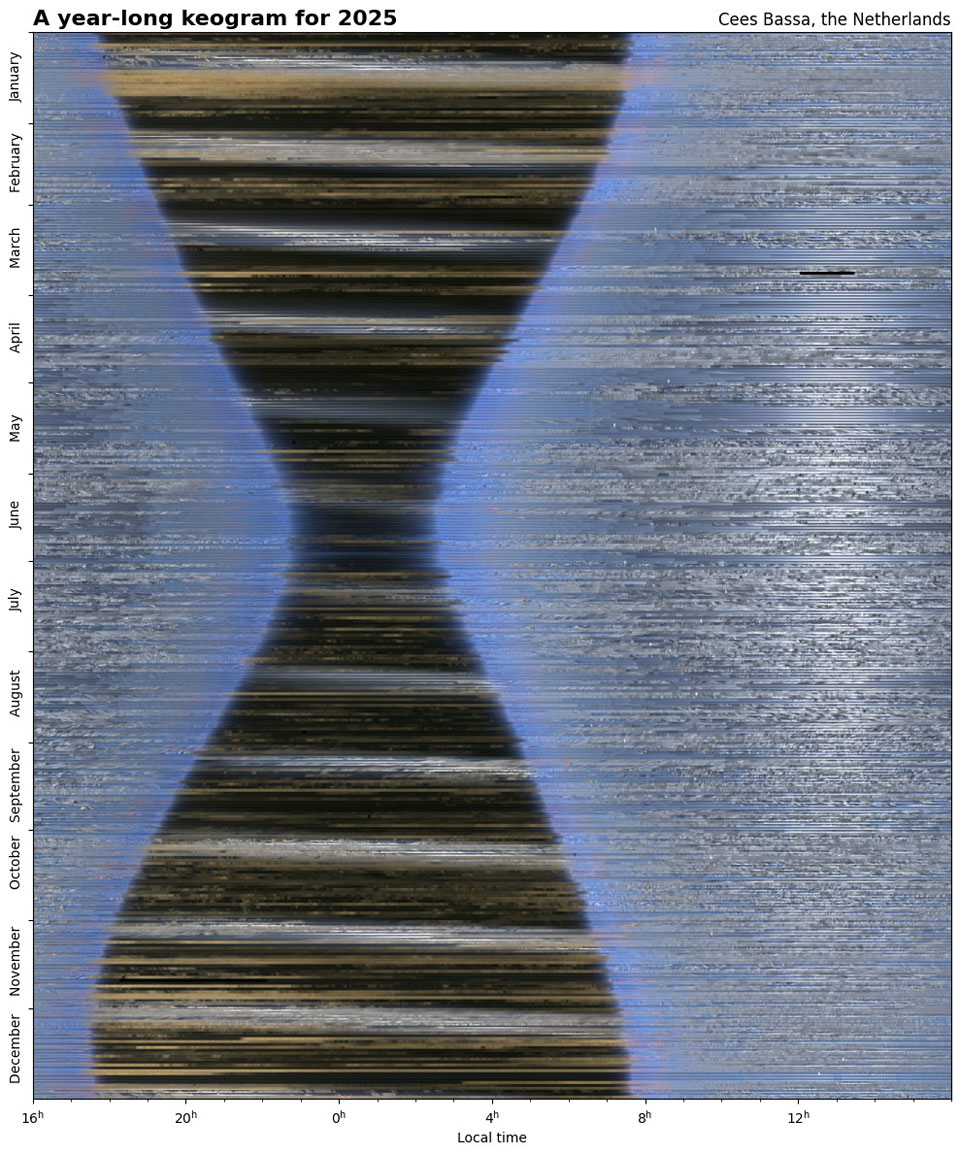
The universe showed off again today — Keogram: The Sky in 2025. Here is what NASA captured:
Why this matters
This scene highlights the Moon. The same physics that lets us photograph it also lets us predict where objects will be tomorrow — which is exactly what real-time tracking is built on.
See it live on ObjectTracer
This connects to what you can track in real time on our 3D globe — explore Moon tracker. Or open the live globe to watch flights, satellites, the ISS and spacecraft move right now.
The science, from NASA's Astronomy Picture of the Day
What if you could see the entire sky -- all at once -- for an entire year? That, very nearly, is what is pictured here. Every 15 seconds during 2025, an all-sky camera took an image of the sky over the Netherlands. Central columns from these images were then aligned and combined to create the featured keogram, with January at the top, December at the bottom, and the middle of the night running vertically just left of center. What do we see? Most obviously, the daytime sky is mostly blue, while the nighttime sky is mostly black. The twelve light bands crossing the night sky are caused by the glow of the Moon. The thinnest part of the black hourglass shape occurs during the summer solstice, like today, when days are the longest, while the thickest part occurs at the winter solstice. Equinoxes can also be located in the keogram, for example the northern-spring equinox from one year ago is about three-quarters of the way up.
Source: NASA Astronomy Picture of the Day (public domain)
More from the Space Journal
- Vaporizing Meteor Photobombs the Lacerta Nebula2026-08-03
- Buck Moon and Belt of Venus2026-08-01
- Psyche Receives Gravity Assist from Mars2026-07-29
- Shadow and Rainbow2026-07-18
- NGC 4372 and the Dark Doodad2026-07-31
- Unusually Smooth Sections of Asteroid Itokawa2026-06-30
← Daytime Moon Meets Evening Star · M27: The Dumbbell Nebula →