2026-07-23
The Large Magellanic Cloud
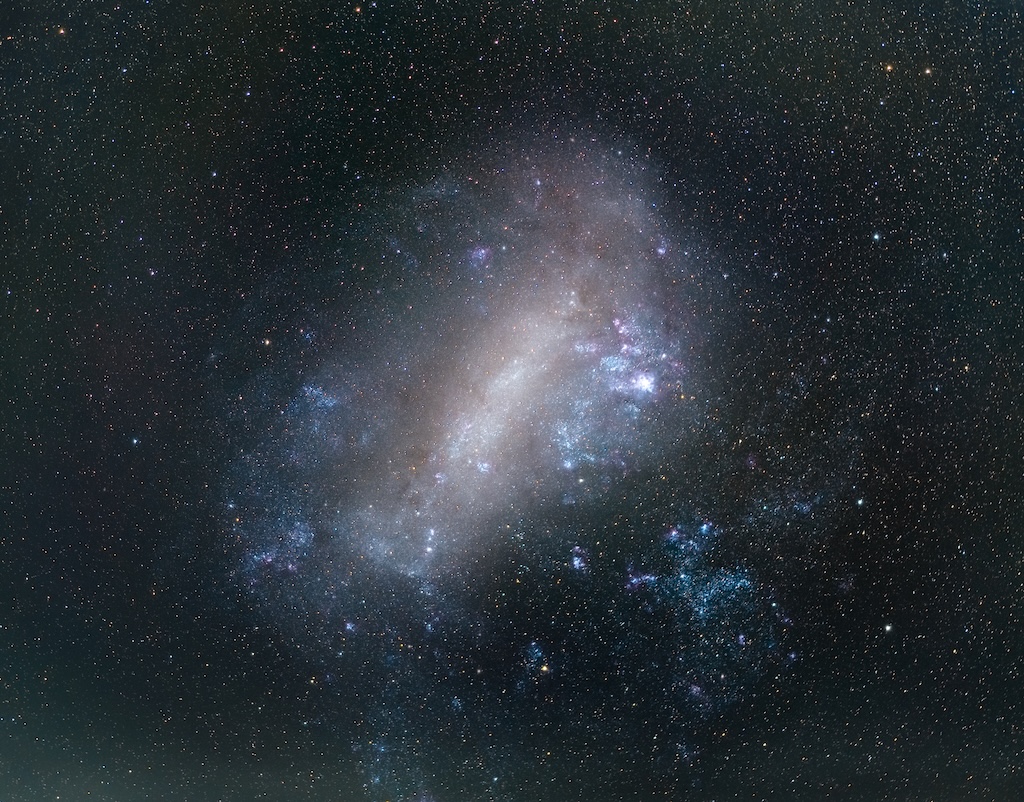
Another stunning view from the cosmos: The Large Magellanic Cloud. NASA explains:
Why this matters
Today's view is a window onto deep-space objects. Images like this aren't just beautiful — they're how astronomers measure distance, motion and the deep history of the universe, turning faint light into hard data.
See it live on ObjectTracer
This connects to what you can track in real time on our 3D globe — explore Deep Space galaxy map. Or open the live globe to watch flights, satellites, the ISS and spacecraft move right now.
The science, from NASA's Astronomy Picture of the Day
Have you ever seen another galaxy with your own eyes? The featured image shows the Large Magellanic Cloud (LMC), one of the closest neighbors of our Milky Way. If you are anywhere south of latitude 20° N (but the further south, the better), you can see it with the unaided eye if you go to a dark sky location, away from big cities and light polution. It is a dwarf irregular galaxy about 163,000 light-years away, and a member of our Local Group of galaxies. Despite being small, with a total mass approximately equivalent to 10% - 20% of the mass of the Milky Way, the LMC is very actively forming stars. This is likely due in part to the gravitational push and pull of tides caused by the Milky Way on the LMC. Some astronomers have predicted that it will collide with the Milky Way in in about 2 billion years.
Image credit: Monica Mesa Text: Cecilia Chirenti (NASA GSFC, UMCP, CRESST II) · Source: NASA APOD
More from the Space Journal
- NGC 3576: The Statue of Liberty Nebula2026-07-20
- NGC 300: A Cosmic Gemstone with Stars and Gas Clouds2026-07-16
- Galaxy NGC 474: Shells and Star Streams2026-07-12
- Triple Shockwave from Sun Crossing Rocket2026-06-15
- The Red Glow of the Cosmic Bat Nebula2026-07-09
- Possible Supernova Remnant in Galactic Center2026-06-18
← The Corona Australis Molecular Cloud and the Chandelier Cluster