2026-08-28
The Sky Turns Above Paranal
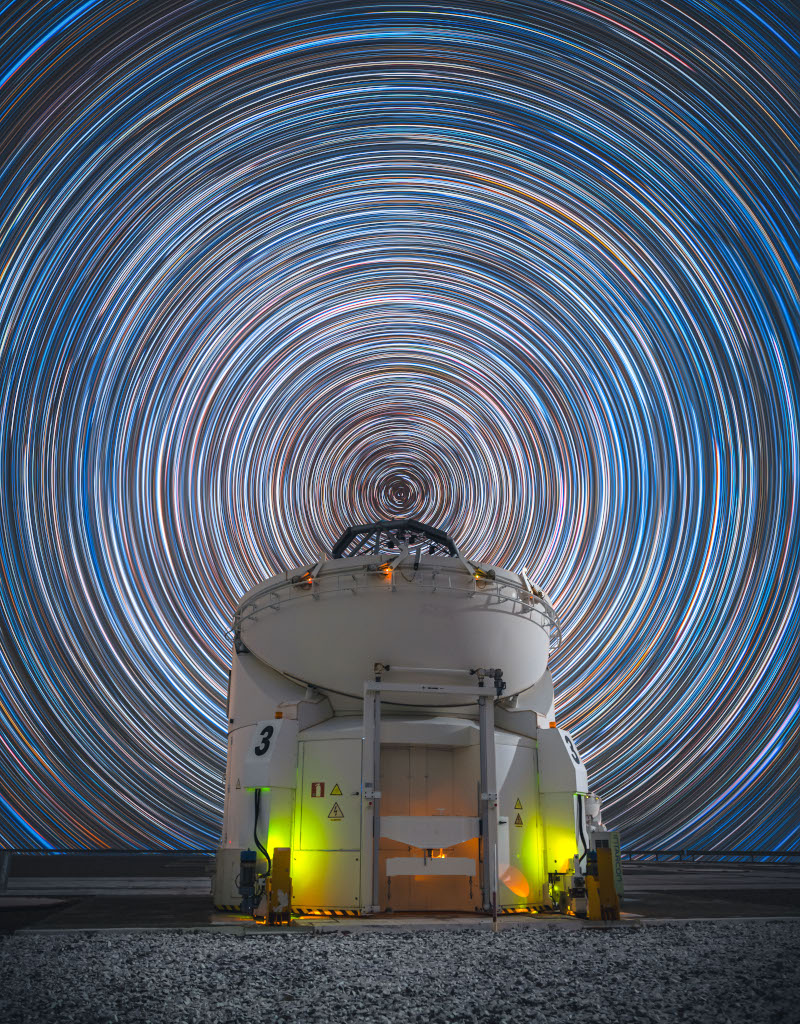
Space never stops amazing us. Today: The Sky Turns Above Paranal. Here is the science:
Why this matters
What you're looking at ties directly to the planets, the night sky. Every frame the world's observatories capture adds another data point to humanity's slowly-assembling map of everything beyond our planet.
See it live on ObjectTracer
This connects to what you can track in real time on our 3D globe — explore Solar System view · Deep Space. Or open the live globe to watch flights, satellites, the ISS and spacecraft move right now.
The science, from NASA's Astronomy Picture of the Day
At the latitude of ESO's Paranal Observatory in Chile, about 25 degrees south, Earth's rotation moves the planet's surface eastward at over 1,500 kilometers per hour. And while that's faster than the speed of sound at sea level, the motion is imperceptible. Still, that motion can be revealed in the apparent rotation of the night sky by photographing star trails. This star trail image was composed from a digital stack of 300 consecutive 25-second exposures made with a camera fixed to a tripod to trace the star trail arcs. The graceful arcs are concentric and centered at the south celestial pole, the southern hemisphere extension of Earth's axis of rotation into space. One of the observatory's operating 1.8 meter auxiliary telescopes, AT 3, appears beneath the south celestial pole, faintly illuminated in the foreground of this well-planned scene from a rotating planet. APOD's main NASA site is moving: From apod.nasa.gov to science.nasa.gov/apod
Image credit: Osvaldo Castillo · Source: NASA APOD
More from the Space Journal
- Witness XZ Andromedae Wink2026-09-09
- Chasing the Moon's Shadow2026-09-05
- Launch of the Roman Space Telescope2026-08-31
- Total Solar Eclipse Over Spain2026-08-13
- Total Solar Eclipse from Greenland2026-08-14
- Bright Perseids from Sweden2026-08-15