2026-08-27
Colorful Aurora over Icelandic Waterfall
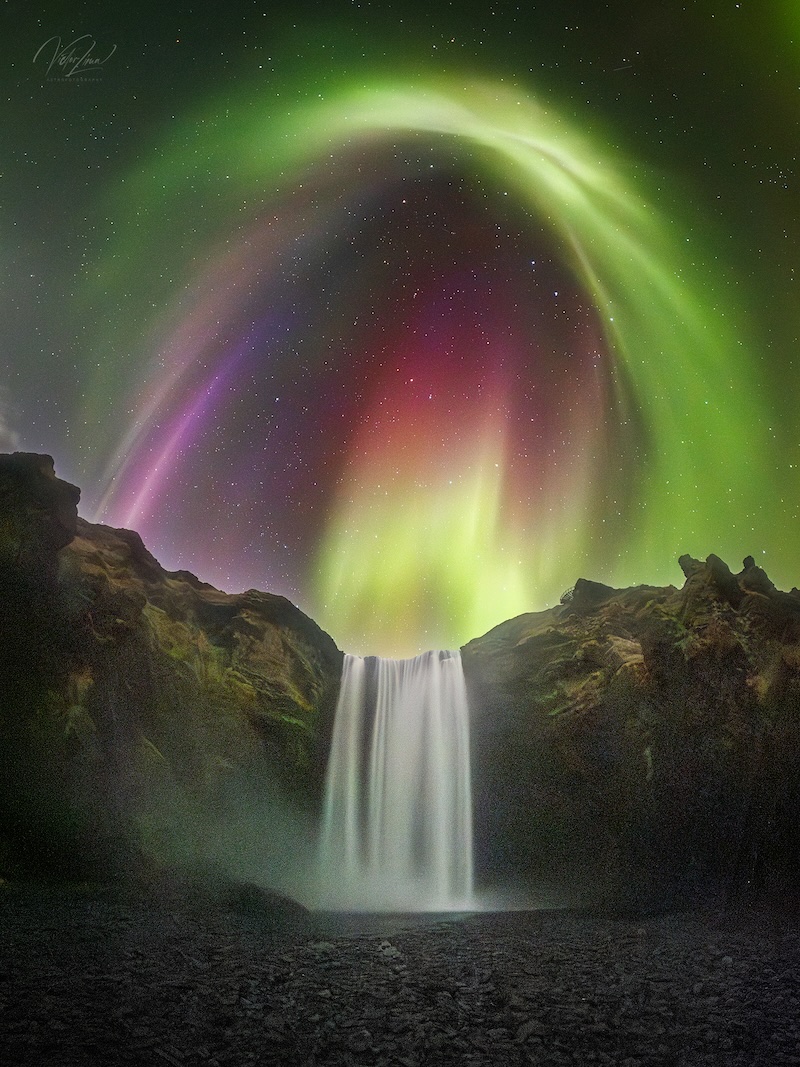
A fresh look at our universe: Colorful Aurora over Icelandic Waterfall. NASA's take:
Why this matters
Today's view is a window onto solar activity. Images like this aren't just beautiful — they're how astronomers measure distance, motion and the deep history of the universe, turning faint light into hard data.
See it live on ObjectTracer
This connects to what you can track in real time on our 3D globe — explore Solar System view. Or open the live globe to watch flights, satellites, the ISS and spacecraft move right now.
The science, from NASA's Astronomy Picture of the Day
What a sight to behold, when a night sky became filled with colors that appeared to rain over the Skógafoss waterfall in Iceland. This image was taken in a single 5 second exposure by the photographer in April 2025. Seeing an aurora is on many people's bucket lists. But it is not easy. It requires high solar activity, dark and clear skies, and usually a viewing location at high latitude. That makes the northern lights more easily seen than the corresponding southern lights, simply because there is less landmass in the Southern Hemisphere, especially around the Antarctic Circle. Auroras are caused by charged particles from the solar wind that are captured by the Earth's magnetosphere and guided by the magnetic field to a region close to one of the poles, where they collide with gas particles in the atmosphere. Different colors indicate interactions with different gases at different altitudes, like oxygen (red and green) and nitrogen (blue and pink). APOD's main NASA site is moving : From apod.nasa.gov to science.nasa.gov/apod
Image credit: Victor Lima Text: Cecilia Chirenti (NASA GSFC, UMCP, CRESST II) · Source: NASA APOD
More from the Space Journal
- Witness XZ Andromedae Wink2026-09-09
- Chasing the Moon's Shadow2026-09-05
- The Eclipse and the Stork2026-09-03
- Eclipse Pair2026-08-29
- The Pelican Nebula in Gas, Dust, and Stars2026-09-07
- NGC 7635: The Bubble Nebula2026-07-27
← JWST Images The Lion's Head Nebula · The Sky Turns Above Paranal →