2026-09-27
Andromeda before Photoshop
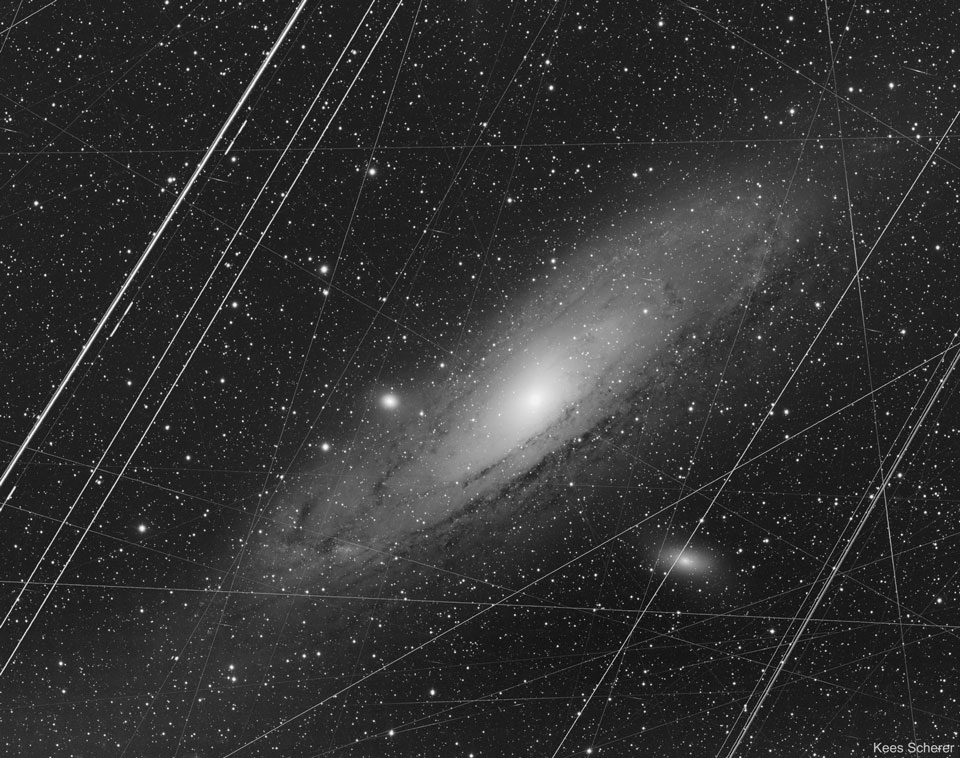
Space never stops amazing us. Today: Andromeda before Photoshop. Here is the science:
Why this matters
What you're looking at ties directly to deep-space objects. Every frame the world's observatories capture adds another data point to humanity's slowly-assembling map of everything beyond our planet.
See it live on ObjectTracer
This connects to what you can track in real time on our 3D globe — explore Deep Space galaxy map. Or open the live globe to watch flights, satellites, the ISS and spacecraft move right now.
The science, from NASA's Astronomy Picture of the Day
What does the Andromeda galaxy really look like? The featured image shows how our Milky Way Galaxy's closest major galactic neighbor really appears in a long exposure through Earth's busy skies and with a digital camera that introduces normal imperfections. The picture is a stack of 223 images, each a 300 second exposure, taken from a garden observatory in Portugal during 2019. Obvious image deficiencies include bright parallel airplane trails, long and continuous satellite trails, short cosmic ray streaks, and bad pixels. These imperfections were actually not removed with Photoshop specifically, but rather greatly reduced with a series of computer software packages that included Astro Pixel Processor, DeepSkyStacker, and PixInsight. All of this work was done not to deceive you with a digital fantasy that has little to do with the real likeness of the Andromeda galaxy (M31), but to minimize Earthly artifacts that have nothing to do with the distant galaxy and so better recreate what M31 really does look like. APOD's email for image submissions has changed. Please see: APOD Submissions APOD's main NASA site is moving: From apod.nasa.gov to science.nasa.gov/apod
Source: NASA Astronomy Picture of the Day (public domain)
More from the Space Journal
- Globular Cluster Omega Centauri2026-09-25
- The Ghosts of Five Supernovas2026-09-24
- Cocoon Nebula Wide Field2026-09-21
- A Treasure Chest in the Carina Nebula2026-09-17
- LDN 1295: The Giraffe Nebula2026-09-10
- The Eclipse and the Stork2026-09-03