2026-06-14
10 Days of Venus and Jupiter
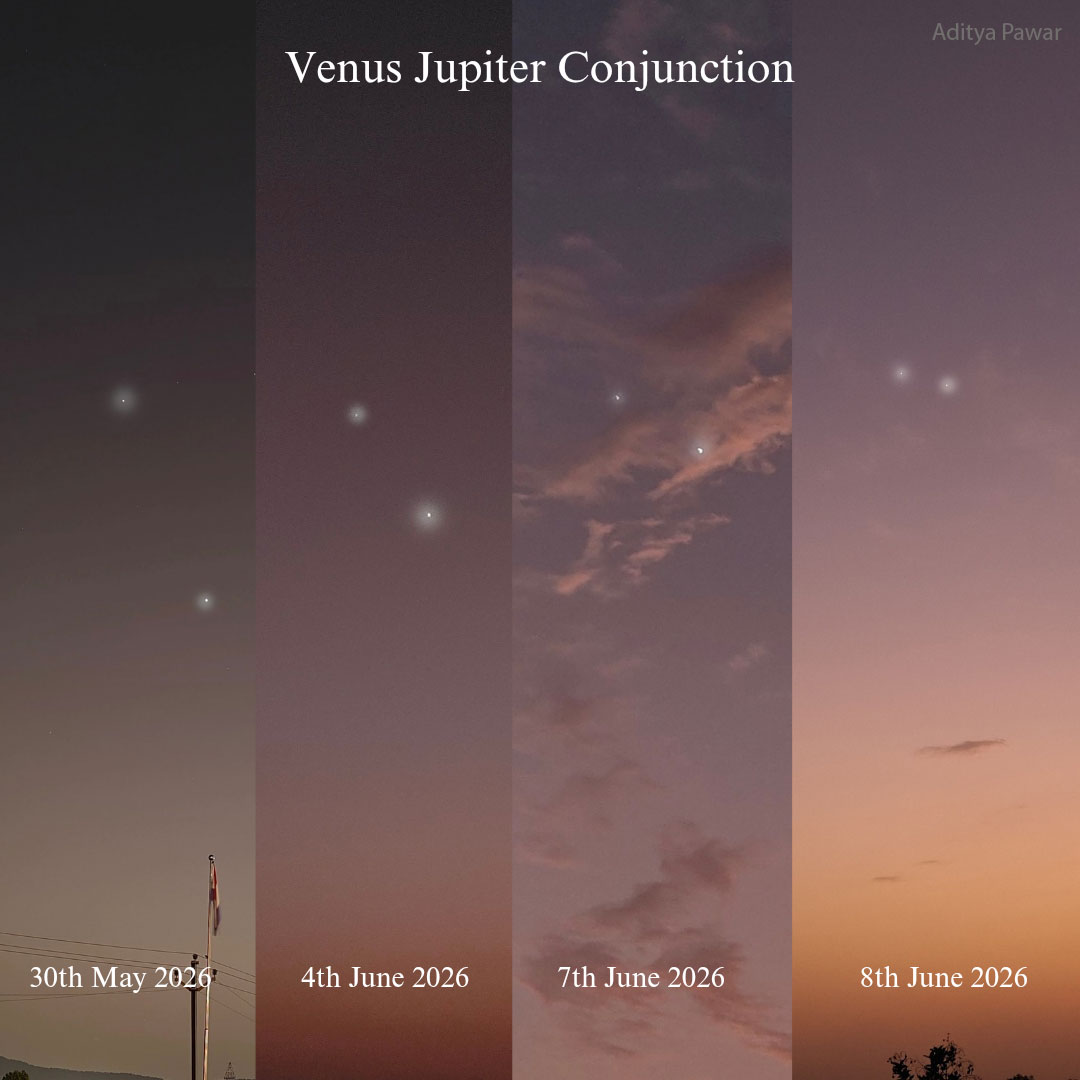
The universe showed off again today — 10 Days of Venus and Jupiter. Here is what NASA captured:
Why this matters
Today's highlight centers on the Moon, the planets, the night sky. Understanding how these objects form and move is the bridge between a pretty photo and the live, data-driven sky we render on the globe.
See it live on ObjectTracer
This connects to what you can track in real time on our 3D globe — explore Moon tracker · Solar System view · Deep Space. Or open the live globe to watch flights, satellites, the ISS and spacecraft move right now.
The science, from NASA's Astronomy Picture of the Day
Venus and Jupiter may have caught your attention lately. The recent close conjunction of the two brightest planets in recent evening skies has been hard to miss. With Jupiter at the top, starting on May 30 and ending on June 8, their close approach was chronicled daily, left to right, in the featured panels from Maharashtra, India. Near the western horizon, the evening sky colors and exposures used for each panel depend on the local conditions near sunset. At their closest on June 9, the celestial pair appeared to be only about three times the width of a full moon apart. Of course, on that date, the two planets were physically separated by over 600 million kilometers in their orbits around the Sun. In the coming days, Jupiter will slowly settle into the sunset glare, but Venus will continue to move farther from the Sun in the western sky to excel in its current role as the brilliant evening star. Gallery: Venus - Jupiter Conjunction of 2026 June
Image credit: Aditya Pawar · Source: NASA APOD
More from the Space Journal
- Psyche Receives Gravity Assist from Mars2026-07-29
- Tranquility and Serenity2026-07-25
- Daytime Moon Meets Evening Star2026-06-20
- NGC 300: A Cosmic Gemstone with Stars and Gas Clouds2026-07-16
- Three Galaxies in Pavo2026-07-03
- Longmore 8: The Hamster Wheel Nebula2026-06-17
← Interplanetary Earth · Triple Shockwave from Sun Crossing Rocket →