2026-07-17
The Dust Trail of Comet Tempel 2
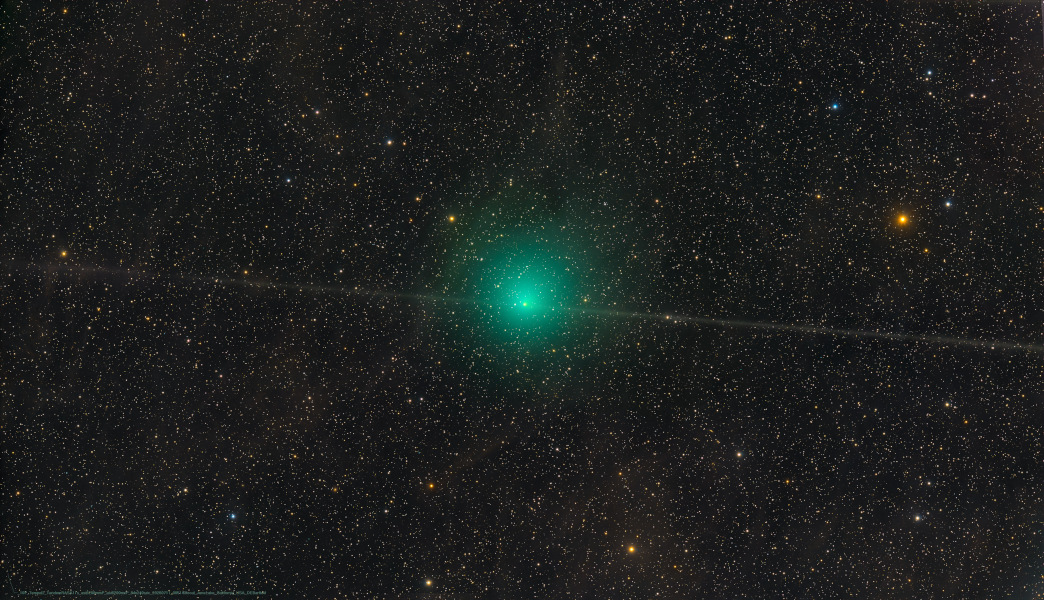
The universe showed off again today: The Dust Trail of Comet Tempel 2. Here is what NASA captured:
Why this matters
Behind the picture is near-Earth objects, the night sky. Light that left these objects long ago is only reaching us now, which is why a single image can double as a snapshot of the distant past.
See it live on ObjectTracer
This connects to what you can track in real time on our 3D globe — explore Asteroid tracker · Deep Space. Or open the live globe to watch flights, satellites, the ISS and spacecraft move right now.
The science, from NASA's Astronomy Picture of the Day
Comet 10P/Tempel 2 orbits the Sun once every 5.4 years. Currently visible in binoculars or small telescopes toward the constellation Capricornus, the periodic comet is captured in this sharp telescopic image from July 11 sporting a bright nuclear region and pretty greenish coma. Remarkably, a thin dust trail, not a typical dust tail, is also seen extending both east and west of the Tempel 2 nucleus. Unlike a comet dust tail, which tends to temporarily fan out in a direction away from the Sun, this dust trail is due to the residual dust shed during many past orbits along this ancient periodic comet's orbital plane. In fact, Tempel 2's dust trail may get a little narrower and brighter from our perspective as Earth crosses through the comet's orbital plane on July 20. Comet 10P/Tempel 2 will reach a perihelion on August 2, and make its closest approach to Earth on August 3.
Image credit: Dan Bartlett · Source: NASA APOD
More from the Space Journal
- Double Lobed Asteroid Torifune2026-07-14
- Dueling Bands over the Atacama Desert2026-07-06
- The Cotton Candy Clouds of Rho Ophiuchi2026-07-01
- Comet R3 PanSTARRS Through Time2026-06-08
- Auroras from Space2026-07-13
- Sibling Supernova Remnants2026-07-02